Friday, February 14, 2014

SnOMG! Time to make snow cream


Get a spoon. - JILL WARREN LUCAS

This post first appeared in Indy Week


Cabin fever due to snow is a rare, practically once-in-a-decade experience for us in the Triangle. But with minimal effort and ingredients from your pantry, you can turn your winter blues into a bowl of creamy snow cream.

The recipe for this simple treat is very forgiving, so don’t feel like to you need to risk an icy drive or sloshy hike to a store. I happened to have half-and-half in the fridge, but you also can use regular milk or, better still, condensed milk you’ve had in the cupboard for the pie you forgot to bake at Thanksgiving. If you’re lucky enough to have some creamy Maple View Dairy buttermilk, give that a try.

You can turn this into chocolate snow cream by mixing in syrup or cocoa mix before adding into the snow. I topped ours with some homemade strawberry sauce canned last summer.


SnOMG Cream

Make four servings

6–8 cups fresh snow

1–2 cups half-and-half, milk or canned milk (divided)

1–1½ cups sugar (divided)


2–3 tsp. vanilla (divided)

fruit jam or topping, optional

Collect fresh, ice-free snow in a large bowl.

Measure 1 cup liquid, 3/4 cup sugar and 2 teaspoons vanilla in bowl. (If using chocolate syrup or cocoa mix, add now.) Use a whisk or fork to combine, ensuring that the sugar is dissolved. Pour over snow and use a wide spatula to fold and combine into an ice cream-like texture. Snow will significantly reduce in volume.

Taste to determine if the mixture is sweet and creamy enough for your taste; note it will be a little crunchy in comparison to traditional ice cream. If needed, prepare more of the liquid-sugar-vanilla mixture, quickly adding and stirring until it’s just right.

Serve immediately, topped with your favorite fruit jam or ice cream topping.

Thursday, February 13, 2014

Snow Day Broccoli Soup - with potlikker

Necessity is said to be the mother of invention, but never discount two days of snow in the South as a source of inspiration.

It’s reasonably safe to drive or walk to Raleigh-area shops now, but why bother when the fridge is full of leftovers? Tim surprised us this morning with a creamy omelet that made good use of a scoop of backfin crab meat, a bit of sauteed onion and a handful of feta. He hit it out of the park, however, with a hearty soup for lunch.

At a glance, this easily could be dismissed as a bowl of basic broccoli soup. But this flavorful batch not only included a quart of decadently rich frozen chicken stock (marvelously gelatinous, thanks to otherwise creepy little chicken feet) but also a pint of savory potlikker saved from collards he cooked earlier this week. The green broth added a certain umami – a salty, smoked porky richness that nonbelievers don’t deserve to enjoy.

The finishing touch came from the heel of an exceptional but forgotten rustic loaf from La Farm. I thought it suitable only for desperate birds, but Tim hacked it into large cubes, rubbed them with a bit of bacon grease and warmed them in a slow oven to create irresistible croutons.

Snow Day Broccoli Soup
Adapted from James Peterson’s Slow-Cooked Broccoli Soup with Garlic and Olive Oil, Splendid Soups (John Wiley & Sons, 2001).

Serves four bored, hungry people.

4 stalks of broccoli, stems peeled if tough
¼ cup sweet onion, diced
½ cup olive oil
2 teaspoons dried oregano
1 tablespoon garlic paste (or four cloves, finely minced)
4 cups homemade chicken stock (or good quality, low-sodium store bought stock)
2 cups potlikker (reserved from cooking collards with a smoked ham hock)
1 tablespoon fresh lemon juice
3-4 cups 1-inch cubes stale crusty bread
1 tablespoon bacon grease (or vegetable oil spray)
Salt, pepper
Freshly grated parmesan cheese

Cut broccoli into florets and trim peeled stems into 1/4-inch slices. Dice onion.

Combine all ingredients except for salt, pepper and parmesan into a four-quart stock pot. Bring to a boil then reduce to a simmer. Cover with a lid and cook for about an hour, or until broccoli is tender enough to break with a wooden spoon.

While soup is simmering, cut stale bread into cubes and rub lightly with bacon grease. Warm in 300 degree oven about 15 minutes or until lightly toasted.


Season soup with to taste with salt and pepper. Ladle into soup bowls, adding a handful of croutons and freshly grated parmesan.

Friday, February 7, 2014

Let’s Lunch: 'Go For the Gold' with Honeybell Chess Pie

Golden Honeybell Chess Pie
It’s not an official Olympic sport, but there is a major competition occurring right now in North Carolina over the relative merits of pie and cake. There’s no debate about the outcome at our house, where we are totally Team Pie.

Our State magazine is about to close out Round 1 of its bracketed Pie vs. Cake contest, which pits favorite Southern pies and cakes in a contest reminiscent of college basketball’s road to the Final Four. One of the contenders is the beloved Lemon Chess Pie, which I feel is sure will overtake its lesser opponent of Chocolate Chess Pie.

My favorite recipe for Lemon Chess is found in Southern Pies, a wonderful collection by my friend and fellow Let’s Luncher Nancie McDermott, who is featured in the special February edition of the magazine for this and a must-have companion book, Southern CakesMcDermott’s recipe is based on the one made famous by Chef Leah Chase of the famed Dooky Chase restaurant in New Orleans. (I have a story in the same issue about Raleigh's wonderful PieBird restaurant.)

With a creamy filling and crispy crust formed by cornmeal that climbs to the surface while baking, Lemon Chess was my choice for birthday pie last month. However, delicious as it is, I was concerned that it might not have enough color to meet the "Go For the Gold" theme of this month's Let's Lunch posting.

Tim and I were lucky enough to receive a box of Florida Honeybells as combined birthday gift. Due to unseasonably cold conditions, these hybrids of the Dancy tangerine and Duncan grapefruit are not as spectacular as past examples, but their bright color inspired me as a substitute for standard lemon juice and zest. 

The result was lusciously golden – or maybe bronze, if you’re not feeling as charitable. If you don’t have access to Honeybells, choose whatever orange variation is at peak flavor from your market.


Golden Honeybell Chess Pie
*Adapted with permission of Nancie McDermott from Southern Pies (Chronicle Books, 2010).

Pastry crust for a 9-inch single-crust pie
2 cups sugar
2 tablespoons cornmeal, preferably stone ground
1 tablespoon all-purpose flour
¼ teaspoon salt
4 eggs, beaten well
¼ cup butter, melted
¼ cup freshly squeeze Honeybell juice (or other flavorful orange)
¼ cup evaporated milk
3 teaspoons grated Honeybell zest

Heat the oven to 350 degrees F. Line a 9-inch pie pan with crust and then crimp the edges decoratively.

In a medium bowl, combine the sugar, cornmeal, flour and salt. Stir with a whisk to blend. Add the eggs, butter, melon juice, evaporated milk and zest. Using a fork or whisk, mix well, stirring and scraping to combine everything evenly into a thick, smooth filling.

Pour into the piecrust and place the pie on the bottom shelf of the oven. Bake until the edges puff up and the center is fairly firm, wiggling only a little when you gently nudge the pan, about 45 minutes.


Place the pie on a cooling rack or a folded kitchen towel and let cool to room temperature. 

Wednesday, February 5, 2014

Crook's Corner Book Prize winner Wiley Cash reads from new book tonight at Quail Ridge

Wiley Cash will read from his new book, "This Dark Road to Mercy," at 7:30pm today at Quail Ridge Books, 3522 Wade Ave., Raleigh. This post first appeared in Indy Week on Jan. 7.

Wiley Cash (Photo: Tiffany B. Davis)
Wiley Cash of Wilmington, author of A Land More Kind Than Home, was celebrated Monday (Jan. 6) night at Crook’s Corner as the inaugural recipient of the famed Chapel Hill eatery’s namesake book prize. 

The contest was open to first-time novelists whose published works were set in the South. More than 100 writers from across the country competed for the prize, which confers $1,000 cash, bragging rights and, in the fashion of Parisian literary cafes, a glass of wine a day for a year at Crook’s.

“It’s just such a fine novel, period. But for it to be a first novel, I think it really knocks it out of the park,” says best-selling author Jill McCorkle, who picked the winning entry from a field of four finalists. “Also, I’m a sucker for a child narrator. I think it is hard to walk that line, but he never once fell off that tightrope.”

McCorkle is a professor of creative writing at N.C. State University and a member of the Fellowship of Southern Writers. She said that all four finalists produced exceptional books, but Cash stood out for “what he had taken on in terms of point of view and weaving everyone’s history into place. He gave himself a very difficult assignment. It was very ambitious and completely successful.”

Cash’s novel has been described as a tragic ballad rooted in the unquestioning faith of a small community in the mountains of western North Carolina. The New York Times chose it as “Notable Book of theYear” for 2013, describing it as “mesmerizing … [an] intensely felt and beautiful story.” 


For his well-drawn sense of place, Wiley earned rapturous comparisons to Flannery O’Connor and William Faulkner. The Richmond Times-Dispatch took its description of the chilling page-turner a step further: “[It] reads a little as if Cormac McCarthy decided to rewrite Harper Lee's To Kill a Mockingbird.”
McCorkle says Cash represents a distinct voice in new Southern literature. She was similarly impressed with his second novel, This Dark Road to Mercy.

“Wiley Cash is the kind of writer who could take you into any situation. These people happen to be Southern, but emotionally, these stories could be anywhere,” she says. “I’m always looking for that story that transcends the place and the period to deliver an emotional truth that anybody, anywhere would understand. I think that’s the goal of fiction.”

Entries are now being accepted for the second annual Crook’s Corner Book Prize, which will be judged by writer Randall Kenan. Author of the award-winning Let the Dead Bury Their Dead, Kenan is a professor of creating writing at UNC Chapel Hill.

Durham company Barley Labs dog biscuits could snag Super Bowl ad

This post first appeared in Indy Week

Experienced planners of Super Bowl parties take their guests' preferences to heart. There's the chili-and-nachos crowd, the cheese-and-crackers eaters, the mindful nibblers of vegetables and fruit.
At the Durham home of Scott Beaudry and Theresa Chu, they set out a special snack for a regular with a sensitive stomach. And if Feb. 2, the evening of the Super Bowl goes right, the treat will elicit tail wags and global exposure for Barley Labs dog biscuits.

The upstart is among four finalists in the national Intuit Small Business Big Game contest, which awards a highly coveted Super Bowl commercial to the winner. Last year's game drew a record-setting 111.3 million viewers—enough to turn a small operation with a growing regional following into a bona fide national brand.

"We didn't have very high expectations at all when we submitted our video," says Chu, who produced the short clip herself. "It was free and easy to enter. We figured, why not take the chance?"

The entry features Barley, their beloved 5-year-old Lab mix, who serves as Chief Inspiration Officer and VP of Quality Control at Barley Labs. The business officially launched in September 2012, but the couple had been using spent barley from Baudry's home-brewing projects to make biscuits long before then.

"Barley has always had a sensitive stomach, so it was important that we knew exactly what was in the treats we fed her," Baudry says. "The vet suggested adding pumpkin puree to her diet, so that's how we developed the pumpkin biscuits."

Other flavors of the crunchy product include all-natural peanut butter and cheddar, the latter of which is sourced from Culture Cow Creamery in Durham. The main product is spent barley procured from Durham's Fullsteam brewery. Baudry struck a deal with the dog-friendly business when it became evident that demand was outpacing the 60 pounds of grain he collected from each batch of home brew.

"The funny thing is, we went to a Durham Bulls game and drank beer at Fullsteam as part of our first visit to the area when we were planning our move from Chicago," Baudry says. "We liked it right away and felt so at home. We're happy about being able to work with them."
Fullsteam owner Sean Lilly Wilson admires the couple's mission. "As an entrepreneurial venture ourselves, we love supporting local start-ups and watching them grow from bar patrons to business owners," Wilson says. "How can you not cheer for a local company that makes dog treats from local beer grain and local cheese?"

The barley saved from the brewing process has been soaked to yield barley-infused water, which is used to make beer. The spent grains have no alcohol content and will not, as some customers have wondered, make biscuit-loving pups tipsy.

Barley Labs biscuits are available online and in several Durham-area businesses, including Fullsteam, where the 8-ounce bags sell for about $6.49 each. In thanks for their own rescue animal, Baudry and Chu donate 10 cents from each package sold to support the Animal Protection Society of Durham. They also feature adoptable dogs from the Triangle and across the country on the Barley Labs website.

The positive exposure already has translated into increased sales and inquiries from out-of-state businesses that want to stock Barley Labs product. Biscuits can be purchased from shops in Pennsylvania, Maryland, Georgia, Arkansas and Iowa.

The couple recently moved its home baking operation to The Cookery, a commercial kitchen space in Durham. Access to industrial equipment means they can produce more biscuits at a time.

Chu says they plan to introduce more products, another crunchy flavor and some soft treats, but have no firm timetable. "Everything's been put on the back burner until we know what happens," she says.

They hope to hear from Intuit before the end of the month and understand that the contest winner will have input into the creative development of the advertisement.

"Barley is definitely the face of our business, but she's a nervous girl," Chu says. "She's really been stressed out with people coming in and out of the house in the last few weeks. I've read that animals can pick up on emotional signals from humans, so we're trying to help her be calm. We're trying to assure her that it all will be worth it."

To view the video entry submitted by Barley Labs to the Intuit Small Business Big Game contest, visit smallbusinessbiggame.com/NC/Barley-Labs/373335. For information about Barley Labs, or where to buy biscuits, visit barleylabs.com.

Atlantic Foodways Conference celebrates the foundations and sustainable resurgence of Lowcountry cuisine

This post first appeared in Indy Week.

A distinguished group of academics, chefs and farmers converged last Friday to both examine the foundations of South Carolina’s Lowcountry cuisine and celebrate its sustainable resurgence during the Atlantic Foodways Conference at UNC Greensboro.


Charleston Chef Sean Brock
This was the first year that the annual conference —which also examined the native foodways and transatlantic impact of Italy, France and Spain—featured high-profile chefs who are influencing contemporary cuisine through their commitment to restore fading traditions. The Lowcountry was ably represented by Sean Brock of Charleston’s acclaimed Husk and McGrady’s restaurants.

“I’ve been lucky enough to watch and be part of the rebirth of one of America’s first cuisines,” said Brock, who grew up in rural Virginia before moving to Charleston during a low point in the city’s now-booming food scene. A decade ago, he added, “People came to this beautiful city from around the world with romantic ideas about great food in their minds, but the rice was Uncle Ben’s and the grits was Quaker instant. They were not satisfied and the cuisine was dismissed.”

As in other historic food communities, Brock and other concerned chefs worked closely with local and national growers, cultural anthropologists and food scientists to identify heirloom plant species that could be restored through seed projects. Some are now thriving, like the Carolina Gold rice, Sea Island red peas and juicy Dancy tangerines used in a four-course dinner curated by Brock.

Keynote speaker David Shields, a prolific author and president of the influential Carolina Gold Rice Foundation, commended Brock on his leadership in sustainable restoration of Lowcountry foodways. “This is not a cuisine of re-enactment,” he said firmly. “What’s been brought back is the ingredients, and those ingredients give permission for creativity.”


Brock's deeply flavored Senegalese Gumbo as prepared by
Chef Jay Pierce of Lucky 32 Southern Kitchen.
The Lowcountry dinner was prepared by Greensboro and Cary chef Jay Pierce of Lucky 32 Southern Kitchen and served at the elegant Proximity Hotel. It started with a benne (sesame seed) oyster stew, a Lowcountry classic that was punched up with glossy bacon from Allan Benton’s legendary Smoky Mountain Country Hams and creamy Old Mill grits from Guilford County. It was followed by Senegalese fish gumbo, whose unexpected spice profile provided a flavorful nod to slaves whose culinary achievements generally were attributed to white plantation hostesses who rarely stepped inside their own kitchens.

Pierce took the lead on a “Roots & Shoots” plate that featured braised pickled turnips and greens alongside the red peas from Anson Mills, which had been simmered in a luscious ham hock broth. Some diners regretted the lack of cornbread while others contentedly slurped the soupy remains. The meal finished with cakelike chocolate and a tangy orange sorbet distinctively drizzled with natural birch syrup.

The Lowcountry sessions featured key voices in the efforts to more fully document the abundance of antebellum Charleston’s farms and kitchen gardens. Shields delivered a powerful discourse that tracked the ways foods migrated and changed – some to the point of extinction through aggressive manipulation meant to adapt to local conditions. He also linked the seemingly “magical” ability of slaves to excel in plantation kitchens to specific marketing of those procured for that very purpose from rice-growing regions of Western Africa.

Marcie Cohen Ferris
Marcie Cohen Ferris of UNC Chapel Hill presented a preview of her new book, The Edible South: The Power of Food and the Making of an American Region, which is scheduled for fall publication by UNC Press. Her remarks focused on the cultural politics of Charleston’s “culinary brand” during the growing tourism economy of the 1930s through the 1950s.


“No city packaged and sold the ‘Old South’ better than Charleston,” said Ferris, noting the port city fashioned itself as the epicenter of all things great and Southern. “Masterminded by white elites, they rewrote the city’s history.”

As represented by an ever-present demure Southern belle, this imagined history ignored slavery by depicting black men in romanticized field labor and women who spoke in vernacular while deploying “culinary wizardry” in well-appointed kitchens. It also dismissed a large Jewish community that established the nation’s second oldest synagogue building, which today is the oldest in continuous use.

By the late 1930s, popular national magazines were printing Lowcountry recipes and touting the appeal of culinary vacations. Some homes near the historic Battery were converted into boarding houses while others attracted Northern socialites like Claire Booth Luce, who became the “invented mistress” of her plantation.

The fascination with the South and its air of high society extended to New York City, where the flagship B. Altman’s department store featured a Charleston garden restaurant complete with a Tara-like courtyard setting.

Recent scholarship has revealed such whitewashed depictions and dumbed-down food as creations of a powerful public relations campaign, but many people still cling to the myths.

"Lowcountry tourism really transformed the flavor and racism of the culinary South in a way that still has resonance and power today," Ferris said.

Wednesday, January 15, 2014

Historic Old Salem offers model for healthy, seasonal eating in new year

Cakes baked in the large hearth at
the Vierling Home & Apothecary.
The new year often inspires resolutions of healthier eating and reducing food waste. For those located near the Triad, an appealing model for both can be found from a very old source: Old Salem Museums & Gardens in Winston-Salem.

The Moravian settlement, established in 1766 by Protestant missionaries from what is now the Czech Republic, thrives as a restored historical village. It includes 22 structures ranging from a boy’s school and housing for single men and women to an African church, gun shop, various merchants and professional offices, as well as the Museum of Early Southern Decorative Arts. Tyler Cox, Old Salem’s manager of community relations, says it has more structures on original architectural footprints than Williamsburg.

Winter garden at the Miksch House.
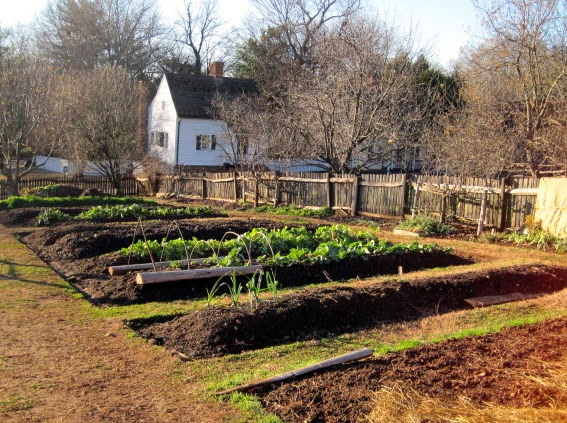
Not surprisingly, growing, cooking and preserving food was a key component of community life. Even in winter, the heirloom garden at the Miksch House remains a hub of activity. During a recent visit, cold frames were protecting tender vegetation, orchards were trimmed and beds were being groomed for spring plantings.

Seasonal hearth cooking and preserving techniques – as well as coffee roasting and butter churning – are demonstrated in homesteads throughout the village. With benefit of immaculate records kept by original occupants, costumed interpreters present the past in context with modern realities. These unscripted, blissfully thee-and-thou-less insights encourage visitors to engage in sensibly informative conversations.

This welcoming stance is in sync with the Moravian’s equitable perspective on hospitality. The lessons are especially appealing when visiting the kitchens and gardens of former private homes and shops, which maintain the foodways of Old  Salem’s industrious forebears. Examples of creative and, importantly, healthful seasonal cooking abound.

Interpreter Coreen Smith demonstrates Moravian foodways
in the kitchen of the Miksch House.
If you think kale salad is a new invention, be sure to swing by the Miksch House at dusk, when the fireplace embers are fading. You're likely to find a bowl of greens just-cut from the winter garden awaiting a simple dressing from home-cured vinegars. Most bottles were infused with herbs and chilies from the garden; one fancy option was a mushroom “ketchup.”

“You eat what you’ve got, and right now, we’ve got lots of kale,” says interpreter Coreen Smith while gazing into a field dotted with leeks, turnips and Swiss chard. Crocks resting atop a cabinet soon would be filled with cabbage to make sauerkraut. “If we’re lucky, the garden will continue to feed us for a few more weeks.”

Typical kitchen tools include red clay
cookware and a sturdy whisk made
of bound birch twigs.
A complete tour of Old Salem’s 22 sites can be done in about four hours, but a leisurely visit provides a glimpse of the typical dawn-to-dusk lifestyle of namesake dwellers. A fire is stoked early in the kitchen of the Vierling Home & Apothecary, a focus of Old Salem’s ongoing fundraising and restoration efforts through the On Common Ground campaign. The blaze is banked not just to tame the morning chill but also to prepare the day’s meals.

Red clay cookware and cast iron Dutch ovens are nestled on the hearth to boil and bake whatever is available from the garden or stored in the larder. Warm apple dumplings and a dense pound cake, with a pound of each ingredient whisked into batter with a bundle of birch twigs, scented the air.

Very little went to waste. Stale bread was grated to thicken soup or, in the hands of a deft cooks, repurposed to make an elegant torte with almond flour, bread crumbs and orange peel. This particular dessert was documented on an original Winkler Bakery receipt – a term better known today as a recipe.

Christian Winkler was the second operator of the town bakery and become one of the community’s most influential citizens. Recruited by the church, which selected a suitable bride as his helpmate, he arrived in 1807.  Known for his fairness and honesty, he fed countless families with breads that sold for pennies a loaf.

Interpreter Jeffrey Sherrill bakes from original
Winkler receipts, including breads,
sugar cakes and wafer cookies.
Winkler likewise depended on seasonal ingredients and saved sugar to make special occasion treats, such as the Moravian sugar cakes that remain popular today. For daily use, professional and home bakers alike used what they had on hand: sugar beets and honey, molasses and sorghum.  

Interpreter Jeffrey Sherrill, who bakes dozens of original-recipe breads and cakes daily, says the wood-fueled ovens at Winkler’s are greatly affected by cold winter winds, which cause uneven heat distribution. This makes it especially tricky to bake the wafer-thin cookies associated with the Moravian community and sold in the bakery.

Old Salem is about a two-hour drive from Raleigh, which makes it an appealing day trip. It is open to visitors from 9:30am to 4:30 pm Tuesday through Saturday and 1-4:30pm Sundays. Not all sites require a ticket for admission, and some buildings in the village are private residences. For details, visit http://www.oldsalem.org or call 336-721-7300 (toll free, 888-653-7253).

Note: My tour of Old Salem Museums & Gardens was arranged by Visit Winston-Salem. Additional posts about things to do in Winston-Salem will follow. For information about other area events and activities, call Visit Winston-Salem at 336-728-4200 (toll free, 866-728-4200).