Showing posts with label Grace Young. Show all posts

Wednesday, November 20, 2013

Chef Amy Tornquist announces schedule of hands-on cooking classes

Chef Amy Tornquist of Watts Grocery has lost count how many times customers have asked her to teach them how to recreate her dishes at home -- or at least learn how to master some basic culinary techniques. She always demurred, saying she just could not balance the hectic demands of being a restaurant chef, running a catering business, opening Hummingbird Bakery and being a good parent to her young children.

Well, now she can. With the help of Matt Lardie, her catering operations manager at Sage & Swift, Tornquist has announced a series of hands-on cooking classes. Because participants will need to roll up their sleeves and have ample room to work, class sizes will be limited to 10 to 14 participants, depending on the topic. (An exception is a wine and cheese pairings class, which is open to 16.)   

"I have done tons (of classes) but not offered them at our own space," Tornquist says. "It took Matt's leadership to get us going. I like the idea of getting to serve a little wine and feed folks and do more hands-on instruction" than is available at some other venues.

All classes will be held at Sage & Swift, 2595 Whilden Drive in Durham, unless otherwise noted. To register for classes, which are expected to fill quickly, call 919-957-7889. Tornquist welcomes suggests for additional classes to be scheduled in the spring.
 
Jan. 15: Southern Pies
Tornquist will provide both a history lesson on Southern pies and hands-on instruction on how to make three classics: pecan pie, buttermilk chess pie and sweet potato pie. She and Lardie, who previously worked for her as a pastry chef, will share the secrets behind a perfectly flaky crust. Participants will get to sample each pie and take home both the recipes for each and individual-size pies to enjoy at home. ($50; 12 person limit)
 
Jan. 29: Pot Roast and Pinot Noir
Warm up with classic comfort foods and well-paired wines. The class will cover three dishes: pot roast, macaroni and cheese, and chili, along with tips for selecting wines to match the menu. Participants will sip and sup while chopping and stirring, as well as take home recipes and doggy bags. ($50, 12 person limit)
 
Feb. 12: Soup for Supper
Tornquist will teach some of her favorite winter soup recipes along with classic accompaniments to turn a bowl of soup into a satisfying winter meal. Details are to be announced, but think butternut squash and a cheddar scone. Also learn how to make her favorite mulled wine. Participants will leave with recipes and containers of soup to enjoy at home. ($50, 14 person limit)
 
Feb. 26: Perfect Pairings: Wine and Cheese (Location TBA)
Learn how to assemble a balanced wine and cheese pairing for entertaining or at-home nibbling. Participants will be introduced to some of North Carolina's best artisan cheeses and sample great wines from around the globe. ($50, 16 person limit) 
 
March 5: Easy Cheese-Making
If you think making cheese at home means pressing a button on a can of Cheese Whiz, get ready to have your mind blown. With assistance from Lardie, who formerly was associated with Hillsborough Cheese Company, participants will learn the basic principles of cheese-making along with recipes for crème fraiche, ricotta and paneer. ($35, 14 person limit)

March 19: Stir Fry 101
One of the world's oldest cooking tools is also one of the most versatile to have in a modern kitchen. Tornquist and Lardie, the latter of whom runs the popular Wok Wednesdays website in collaboration with wok cooking expert Grace Young, will teach how to use a wok to stir-fry, steam, braise, deep-fry food, as well as smoke meats and vegetables. Participants will learn three easy recipes that demonstrate the versatility and simplicity of stir-frying. Registration includes a new wok and wok spatula. ($55, 10 person limit) 

Wednesday, July 25, 2012

Blunderproof Kung Pao Chicken


With help from an especially adept sous chef, I returned home Monday tonight with a complete mise en place ready to prepare Grace Young's Kung Pao Chicken for dinner. Described by the wok guru as one of her favorite recipes from Stir-Frying to the Sky's Edge - and the selected post for this week's Wok Wednesdays online event - my only task was to locate the two tablespoons of chicken broth Tim was unable to find in our typically stock-stuffed freezer.


The bags of cubes and containers of broth that often tumble from my freezer were oddly missing from sight; a signal, at long last, that it really is time to replenish. In its place I made a scant cupful of broth from a liquid concentrate, a reasonable substitute since everything else was so perfectly in place.

Or so I thought. I messed up the maestro's organization by stashing the excess broth too close to the prep station. Tim handed me each ingredient with the confident skill of a surgical nurse - scalpel! clamp! red bell peppers! - until I misspoke and asked for broth instead of the savory mix of soy sauce, rice wine and toasted sesame oil actually called for.

I didn't even look when I splashed in about 3/4 cup of light golden broth, which should have been dark and  shimmery. I realized the blunder about a minute later when the stir fry failed to gain the classic lacquered look of Kung Pao. In rapid succession, I strained off the excess liquid, added a teaspoon of corn starch and the proper sauce, then held my breath as I tossed the contents in the bubbling mix.

In just a minute or two, it assumed expected appearance and was brought to the table still steaming. A photo I posted as a preview earned admiring comments from friends who were unaware of how close I came to completely ruining the dish.

Photo @TheKitchn
Once my adrenalin rush subsided, I had to admit I went too weenie on Grace Young's recommended heat scale. I had planned to substitute the 4-8 dried red chiles with a generous shake of red chile flakes but opted instead to use two fresh jalapeno peppers in our market stash. Even with seeds, their sweet almost-heat should have been amplified by some red chile.

One ingredient that absolutely must not be messed with is the half-teaspoon of roasted and ground Sichuan (or Szechwan, etc.) peppercorns. I can't imagine anything else that comes close to the floral, almost fruity essence of this critical ingredient. Most well-stocked grocery stores carry this, as well as local and online specialty spice shops. Splurge a few bucks and get a jar; you'll be surprised how often you sneak it into favorite dishes.

Monday, July 2, 2012

Substitutes yields satisfying side dish for post-season stir fry


Sugar snap peas are for me what the sight of a robin is to many people: an assurance that spring is well on its way. Their crisp sweetness, devoured straight from market tubs before they can be transferred to a proper bowl, fully earns their sunny, promising name.
Variation on Grace Young's Stir-Fried Sugar Snap Peas
with Shitake Mushrooms, served with panko-crusted trout.

I happily ate my share in those early weeks and didn't entirely notice their absence as other early summer vegetables followed. So it was with some sadness that, while on a belated market run for last week's Wok Wednedsays post about Grace Young's Stir-Fried Sugar Snap Peas With Shitake Mushrooms, I found not a single sugar snap pea.

The basket that normally is full of plump shitakes also was bare - but on another shelf I spiked a package of maitakes, otherwise knows as Hens of the Wood. Assuming commonality of name communicated a reasonable (if perhaps distant) culinary kinship, I bought them. While clearly different varieties, a quick online search was reassuring in that both reportedly "boost immune function, support cardiovascular health, and show promise in lowering the risk of - or treating - cancer." So far, so good.

Tim likewise had no luck with sugar snap peas at the farmer's market, but he did bring home a bag of just-picked local green beans. Trusting the heat of my wok to make it all work, and imaging Grace Young's encouraging voice, I forged on to prepare a heavily tweaked version of the recipe from her James Beard award-winning Stir-Frying to the Sky's Edge.

Maitakes are better known as Hen of the Woods.
Since the direction call for light stir-frying of the snaps, and my green beans were a bit tough, I gave them a quick steam bath in the microwave with the clinging rinse water. Conversely, the maitakes were more tender and did not absorb all of the savory stock as described. As such, I opted to not add the last spoonful of stock and let the green beans soak up the remaining mushroomy broth.

To my relief, the end result was a reasonable rendition of the image featured in her book - which is saying a lot since most of the ingredients were substitutions. The beans retained an appealing crispness and the ginger-glazed mushrooms surrendered to drape them luxuiously. 

I'll certainly make this variant again over the course of the summer, but join me in marking the calendar now to take even better advantage of next year's spring arrival of sugar snaps.

Monday, June 11, 2012

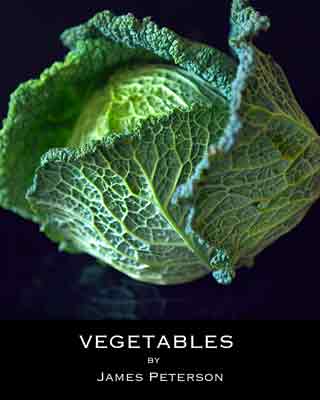
14 years later, a new look at a classic: 'Vegetables' by James Peterson

It's that most wonderful time of the year when tables at farmer's markets overflow with the rainbow beauty of summer produce. There are squash of every shape and color; strawberries, blueberries and plump blackberries; sweet onions and even sweeter corn, and, oh my, at long last, tomatoes that actually taste like tomatoes.

But wait. There also are some very odd-looking roots, a peck of unfamiliar peppers and confusing assortment cabbages, greens and herbs. You might find yourself wondering: Where the heck did all this come from? And, more importantly, how in the world do I cook it?

"A lot more vegetables are available now than when Vegetables was first published 14 years ago," said James Peterson, whose classic James Beard Award-winning book had gone out of print. "One of the book’s main purposes is to serve as a sort of reference guide: what a vegetable looks like, how it can or should be cooked, how to trim it."

In the handsomely illustrated new Ten Speed Press edition, Peterson provides step-by-step instructions on, for example, how to minimize waste while trimming intimidatingly bumpy Jerusalem artichokes, how to whittle what looks like dirty sticks onto slivers of stir-fry-ready burdock root, and how to dramatically carve a roasted rutabaga like a roast beef. He also offers new perspective on a comprehensive array of vegetables familiar to most home cooks.

Peterson, who has earned a revered status for a series of intensely researched single-topic cookbooks, wrote the revised Vegetables over a yearlong season of shopping and cooking at New York's bountiful green markets, which serve as an urban oasis for everyone from top chefs to home cooks and those trying to recreate the distinct tastes of distant homelands.

While the first edition of Vegetables impressed critics as comprehensive, Peterson has lushly expanded what he confidently calls "the most authoritative guide" with a staggering array of "new" vegetables, many of which have deep but threatened heirloom roots. While decidedly not a cookbook for vegetarians, it is a desirable addition to the collection of anyone who loves vegetables.
Photo @aneducatedpalate.wordpress.com

One of the many additions that was new to Peterson was long beans, the aptly-named 12-18 inch green beans that are often used in Asian cooking. His Long Beans with Peanuts and Garlic is one of the more than 300 recipes in the collection.

Peterson cited the giant beans as an example of how even those confident cooking with green beans might be stumped by a long bean, which is relatively tough and needs a longer cooking time. The trick is to cut them into manageable, faster-cooking segments.

 "The Chinese are superstitious cooking some long foods - you'd never break up long noodles, which signify long life - but these are best cut small," said Peterson, acknowledging that wok guru Grace Young (whose recipe for Candied Lotus Root is featured) deploys a similar technique. "If you just steam or boil them, you might be disappointed."

A sizable chunk of the new volume is dedicated to Asian vegetables, especially the many bok choy and seaweed varieties that have made their way from small specialty markets to mega-mart shelves. It also recognizes the impact of Latino consumers, who have created a demand for, among other things, cactus pads (nopales), heritage chiles and delicate zucchini flowers.

While some untried vegetables may poke home cooks outside of their comfort zone, Peterson said there are plenty of unfamiliar options that can be cooked in very familiar ways. Since he doesn't expect even the most ardent fan to tote the nearly 400-page book to the market, he recommends talking to growers and summoning the courage to try new things.

James Peterson
He also urges a light touch in the kitchen to take full advantage of a farmer's hard work without overcooking or masking a vegetable's inherent flavor with too many ingredients.

"People do tend to overcook, and it’s not just applying too much heat over time. They just overdo it," Peterson said. "Culinary students especially tend to over-complicate things. You can see it coming then they all get out the red bell peppers. I think it’s a general insecurity that it’s just not enough on its own."

Peterson concedes that not everything he tested and tasted in the name of culinary completeness is something he'd eat on a regular basis.

“Ugh, taro root,” he said with an unmistakable shiver. “I can’t really say in all honestly that I would go home and cook that. It’s kind of starchy, gooey, nondescript. I thought it should be in there because its become common but a lot of people don’t know what to do with it.”

While some dishes may not be repeated, Peterson was not shy about pointing out some of his favorites. "The onion tart is really very good," he said. “Another one I love, with is somewhat a bit of work, is the potted stuffed cabbage (see related story).”

Onion Tart
Reprinted with permission from Vegetables by James Peterson, copyright © 2012. Published by Ten Speed Press, a division of Random House, Inc.

2 tablespoons unsalted butter
6 medium onions, very thinly sliced
1 (10-inch) Tart Shell, baked
2 cups milk
4 large eggs, beaten
1 teaspoon salt
Freshly ground black pepper
Tiny pinch of freshly grated nutmeg

Makes 8 first-course servings.

Preheat the oven to 300˚F.

Melt the butter in a large, heavy-bottomed pot over medium-high heat and add the onions. Stir the onions every few minutes until they soften and begin to turn pale brown, about 30 minutes. If the onions start to brown sooner, turn down the heat.

Spread the cooked onions in an even layer in the tart shell. Whisk together the milk, eggs, salt, pepper, and nutmeg and pour this mixture into the tart shell. Bake until the liquids set—you can see this by gently moving the tart back and forth and verifying that the liquid does not move—in 45 to 60 minutes. Let cool for 10 minutes. Serve in wedges.

Thursday, May 17, 2012

Stir-Fried Garlic Kale


I had good intentions to submit this blog in time for the debut of Wok Wednesdays, a new food community blog celebrating Grace Young's James Beard Award-winning book Stir-Frying to the Sky's Edge. I also intended to make the recipe as written.

Well, neither happened, but I still think I achieved success.

With advice from Young herself, I tweaked her recipe for Stir-Fried Garlic Spinach to make use of a large bunch of tender kale I had in the refrigerator. It needs to be prepped and cooked a bit differently, but the variation was simple and the results delicious.

Even with young kale, you'll likely need to strip each leaf of its tough core. Stack small handfuls of trimmed leaves and roll like a tight cigar, then cut crosswise into 1/4-inch strips.

In a small bowl, combine a tablespoon each of broth - I used a cube of frozen vegetable stock - sherry and soy sauce. Stir to combine.

Start the stir-fry as described on page 202. After flipping the greens a few times, add soy mixture and cover for 1 minute to steam. Remove lid and stir fry constantly until liquid cooks off. Add salt and sugar as directed. Toss a few more times then transfer to a serving dish and serve immediately.

NOTE: Be sure to check http://wokwednesdays.wordpress.com/ to see how other bloggers addressed this week's recipe, and join us for future posts!

Monday, April 2, 2012

Double blessings with hope for 'wok hay'

I can't remember the last time I was so happy to be wrong.

I've been using the same wok for about 30 years. I've been proud of its dark, non-stick patina and felt confident stir-frying countless meals. Sure, I'd flirted with sleek stainless versions and I wondered, as anyone might, if a long-handled model might be more satisfying. Yet I remained faithful.

But I recently realized that my wok's round, Cantonese shape and my standard Western gas range lack the makings of a happy marriage. Memories of soppy, unintended braises and limp vegetables resurfaced like forgotten, but unresolved, arguments. And those stubby, blazing hot metal handles? Let's not even go there.

The only way to breathe life into my old wok, I realized, was to replace it with a new, flat-bottom, carbon steel one designed to make the most of American stoves. I followed the advice of wok guru Grace Young, who was in Chapel Hill last month for a gastronomic feast in her honor at Lantern and a reading at Flyleaf Books presented by Culinary Historians of the Piedmont North Carolina.

Raymond Leung of Classic Silver Wok
1322 Fordham Blvd., Chapel Hill
At Lantern, I had the good fortune to dine with both Young and Raymond Leung, owner of Classic Silver Wok in Chapel Hill. Leung's unassuming shop caters to everyday locals who load up giant bags of Jasmine rice and to culinary superstars like Lantern's Andrea Reusing. Needless to say, I asked for his help in selecting a new wok.

An unforeseen delivery delay postponed acquisition until today, but now that I have it I can hardly believe I fought with my wobbly old one for so long. To season and imbue it with "wok hay" -- the "breath of a wok" Young so eloquently describes -- I decided to give it a double blessing: first the technique Young recommends, and then the method suggested by Leung.

After giving it a good soapy scrub -- the one and only time detergent will come close -- I dried it well and set it on a high flame. Into a shimmering puddle of fragrant peanut oil I tossed in sticks of juicy ginger and swirled it around the pan with a handful of green onions. I then cut the onions into two-inch lengths, added them to the pan and dialed back the flame to medium.

I flipped and pressed the mixture into the bowl until it disintegrated about 10 minutes later, then used paper towel to brush out the crumbs and rub a thin coat of the remaining oil over the pan. The towel came away with a trace of gray, evidence of the wok's manufacturing process.

After the wok cooled, it was time for Leung's technique, which involved a sturdy block of firm tofu diced into cubes. After bringing the pan back to temperature, I poured in a drizzle of peanut oil and added the tofu. The pale white cubes grabbed the remaining gray silt like a sponge, leaving the pan clean and the tofu in precisely the unappetizing condition Leung described.

Now ringed with a pale cast of color, the wok appeared ready for real cooking. Tim had bought several bunches of slender asparagus from the market, as well as sweet spring onions. After heating the wok and quickly reaching the magic moment when, as Young describes, a drop of water vanishes in a flash, I poured in a final tablespoon of peanut oil and swirled the pan to coat. Some minced ginger and thin slices of onion followed, along with a generous shake of Asian Sprinkle. Next came two bunches of asparagus, trimmed into two-inch lengths, and a handful of raw cashews. I stir-fried constantly, about two minutes, until asparagus was bright green and tender crisp.

I thought I was done at that point, but the result was too gingery for my taste. I turned the heat back on, adding about a teaspoon of sugar and a splash of sweetened black vinegar. It cooked just long enough for the vinegar to absorb and evaporate, less then a minute, and gained a restaurant-quality sheen I was pleased to serve. I sighed -- and could almost swear I heard my new wok do the same.

With Grace Young at Flyleaf Books in Chapel Hill.


Sunday, March 18, 2012

Grace Young: Humble woks even the playing field for home cooks

Dear Dr. Wok:
Please help me. The fire that used to burn in our relationship has gone cold. What once made me sizzle with anticipation has turned to soggy mush. Where I used to see balance, beauty and dignity, I now can’t ignore a distinct, almost drunken wobble. My grip has become slippery. Our love has lasted about 30 years, but I think the time has come to say goodbye. What should I do?

If such a mystic for downtrodden wok users really existed, it would point to a sole source for relief.  Grace Young, dubbed everything from wok evangelist to empress of stir fry, prescribes a simple solution for Western cooks who long for the crisp, deeply flavored results – without the gloppy sauces – of popular take-out eateries.

“You have a round-bottom wok, don’t you,” she said, as if checking my pulse by phone from her New York City apartment. “The reason I write books is that stir-frying is a culinary term that’s totally accepted in America. But when they go to cook it, the majority of Americans are frustrated with the results.

“Round-bottom woks are made to cook in a Chinese hearth stove over a fire,” Young explained, noting that adjustments must be made to accommodate non-commercial, lower-BTU American stoves. “You need a flat-bottom, carbon steel wok so it can cook closer to the heat.”

Young will talk about wok cookery as the guest of Culinary Historians of Piedmont North Carolina (CHOP NC) at 7 p.m. Wednesday at Flyleaf Books  in Chapel Hill. Her culinary genius also will be celebrated Tuesday night at Lantern, where Chef Andrea Reusing will prepare a spring menu based on Young's award-winning cook books. For reservations, call 919-969-8846.

My aged, curvy wok is carbon steel, and it has achieved an enviable patina since I acquired it along with my first apartment. But the smarter, more modern design minimizes unintended steaming and, as an added benefit, features a long wooden handle, plus a small helper one, that makes keeping a jug of burn-cooling aloe under the sink no longer a necessity.

If you hope to achieve a degree of stir-fry Zen, don’t be tempted by a fancy stainless-steel model, or one coated with a non-stick finish. And, let us all say hallelujah, don’t dare cast your eyes on an electric one.

While Young could make a fortune selling a celebrity line of cookware, she instead suggests seeking recommendations from family-owned wok shops. If you can’t find one, she recommends San Francisco's The Work Shop (www.wokshop.com), where many budget-friendly options are available.

Grace Young's Classic Dry-Fried
Pepper and Salt Shrimp
“There is so much about cooking these days that is elitist. You can spend all your money on All-Clad, and people look down on you if you don’t have certain ingredients,” Young said. “What I think is extraordinary about stir frying is that is makes less seem like more.

“Even if you’re the most wealthy person in the world, your stir fry isn’t much different from a peasant – if you do it right,” she said. “The ingredients don’t have to be extraordinary. They just have to be fresh.”

Combine this humble cookware with the coming abundance of competitively priced farmer’s market vegetables, and you’ve got all you need for quick, affordable and flavorful family meals. For example, Classic Dry-Fried Pepper and Salt Shrimp and Stir-Fried Cilantro with Bean Sprouts and Shrimp, two of several recipes posted on her website, would be terrific with fresh-caught Carolina shrimp.

Stir-Fried Cilantro with
Bean Sprouts and Shrimp
While Young has published hundreds of recipes in three popular  books, most recently the James Beard Award-winning Stir-Frying to the Sky’s Edge, she insists that delicious, spontaneous suppers can be produced in minutes by relying on the freshest seasonal ingredients. A stir fry made right now with tender asparagus will naturally caramelize and need scant seasoning. But if you try to recreate the experience with woody November asparagus, you're bound to be disappointed.

“The goal is to just accentuate the inherent flavors,” she said. “Really, it’s a frugal and healthful approach to cooking.”

Young said the method should appeal particularly to those taking heed to the Archives of Internal Medicine's startling warning about the health risks associated with eating red meat.

“I always shake my head when I see a wok recipe that includes a pound of beef or even more chicken,” she said. “I ran the Time-Life Books test kitchens for 20 years. I know for a fact that if you try to cook more than 12 ounces of beef in a wok it just goes gray and foamy.”

Too much meat also drops the wok's temperature, which must remain consistently high to sear and not steam. While ingredients can be dried with paper towel and cooked in batches to minimize unwanted braising, Young maintains that it’s better to make multiples of a single recipe than to tinker with ratios.

Young’s current book includes a vast array of meals made in the kitchens of Chinese chefs and home cooks who have scattered around the globe, and the local influences are apparent. In Trinidad, for example, rum takes the place of traditional rice wine.

One particularly interesting recipe deploys peeled watermelon rind as a substitute for hard-to-find fuzzy melon. It’s a resource penny-wise Southern cooks have long used for pickles. “You don’t waste it, where the rest of America tosses it away,” Young said.

Though she admits the recipe is not one of her favorites, Young said she was intrigued by the waste-not ethic that led cooks to make use of the amino acid-rich but otherwise bland white band, which is sliced into thin wafers for a crunchy bite.

Her ongoing research into stir-fry methods and technique – she’s currently pondering a new book proposal – serve to deepen her respect for it as a “chameleon cooking technique.”

“It can adapt and absorb different cultures. For example, if you can’t find Chinese broccoli, use American broccoli,” she said. “For me, that’s what it all about: adapting traditional techniques by using regional variations or what’s in season.”

While Young encourages home cooks to exercise creativity with their wok, she recommends against trying to imitate the physical style of experienced restaurant wok cooks whose balletic elegance mesmerizes customers in the take-out line.

"That jerking motion with the wok, where the vegetables are tossed into the air, is called the pao action. It's a beautiful thing to watch someone who really is one with the wok, but the pao is not very effective at home as it's counter productive to keeping the pan properly hot," Young cautioned. "If you stick with a flat-bottomed wok, you'll spend less time cleaning the kitchen floor and more time eating."