Showing posts with label cookbook. Show all posts

Monday, August 25, 2014

Hadassah speaker to describe Jewish cooking around the world, from generation to generation


Greta Schiffman will be the guest speaker for the Greater Wake County Chapter of Hadassah at an event to celebrate its new community cookbook: l’dor v’dor: from biscuits to briskets. Greta will talk about Jewish food around the world at 7 p.m. Sept. 9 at Temple Beth Or, 5315 Creedmoor Road, Raleigh. The event is free and light refreshments from the cookbook will be provided. 
Copies of the cookbook, which features more than 300 recipes from members, will be sold for $20 each. Proceeds benefit Hadassah Hospitals and vital medical research underway in Israel.


Some people think cooking fresh food for their family is a drag. Not Greta Schiffman.

“Cooking has always been a joy and an adventure,” says Greta, a retired kosher caterer who has lived and cooked around the world. “Also, why go out when I can prepare meals better with better ingredients?”

It wasn’t always like that, however. Greta and her sister both didn’t start cooking until they left home as their mother was a bit territorial about her kitchen. “She had a hard time sharing,” Greta says. “She wasn’t a gourmet cook, but she was a phenomenal baker. I think she felt that if she taught us to bake we wouldn’t ask her to help us with our baking.”

Greta Schiffman
Her mother’s baked goods were well known in their hometown of Poughkeepsie, located in upstate New York near the Culinary Institute of America. In fact, when their synagogue would have bake sales, most of her contributions were sold before people ever got through the door.

“Her rugelach and especially her yeast cakes were very good,” she recalls. “She was an ethnic cook who learned from her mother, who was Russian. They used to put up yeast cakes for the Sabbath. I remember that, those yeast cakes would be sitting Thursday night on the radiator when I was a little girl.”

Greta, a former public school teacher, became avid about taking cooking classes, often from chefs at top restaurants.  She and her husband, Saul, enjoyed entertaining, which gave her a chance to show off new skills. People often begged for her recipes, saying her food was better than anything they could buy in area restaurants and shops.

As Greta’s skill and confidence grew, she chaired cooking committees for her synagogue and civic organizations. It became a constant in her life when, as her husband’s career advanced, they moved every few years.

In the 1980s, when the Schiffmans lived in Tampa, Fla., she quit teaching and started baking and cooking for friends at her new temple. Before long, she partnered with a woman to create Simply Delicious, a kosher catering business. The start-up was flourishing when Saul was transferred to Japan.

“I told him he’s ruining my life,” quips Greta, who soon found work teaching English to women through Western cooking classes. “I learned a lot about Japanese cooking and traditional ikebana floral arranging, but all they wanted to know was how we cook and entertain in the US.”

When they returned to the states, the Schiffmans moved to Raleigh. She worked part-time baking for a small catering business that grew into the Tuxedo Café at the old North Hills shopping center.  When the business was sold, she started baking at the Irregardless Café.

Raleigh remained their base while Saul’s career took them back to Japan and later to Australia. They are both retired now.

“I’ve always found cooking very therapeutic, especially baking,” she says. “But I’ve worn out my hands. I’ve had two hand operations. Also, my husband was tired of his car always smelling like food.”

Greta was always protective of her recipes while working as a caterer, but she has shared several of her best that are included in l’dor v’dor: from biscuits to briskets, the new community cookbook published by the Greater Wake County Chapter of Hadassah.

“I am happy to be part of it,” says Greta, whose three daughters are excellent cooks like their mother. “It’s a really wonderful thing to add l’dor v’dor to my collection of cookbooks. I have books from different Jewish organizations, including National Hadassah, and one from my temple in Poughkeepsie from many years ago that I still use all the time.

“Someone just asked me about getting a copy of l’dor v’dor, and they’re not even Jewish. They wanted to have a really good exposure to Jewish cooking,” she adds. “It’s good to have so many great Jewish recipes to treasure and share.”

If you are unable to attend the Sept. 9 event but would like to order copies of l'dor v'dor: from biscuits to briskets at $20 each, send a check made out to Greater Wake County Chapter of Hadassah to: Rita Kessler, 10504 Parsley Court, Raleigh 27614. For information about our Hadassah chapter, please visit our website or follow us on Facebook.

Tuesday, November 19, 2013

Frances Mayes brings the flavor of Tuscany home for the holidays

Author and cookbook writer Frances Mayes will be the guest speaker at the 7 p.m. Wednesday meeting of Culinary Historians of Piedmont North Carolina (CHOPNC) at Flyleaf Books in Chapel Hill. The presentation will include samplings of her freshly pressed Bramasole Olive Oil. The event is free and open to the public.

Frances Mayes (Photo by John Gillooly)
While it may be wrong to judge a book by its cover, Frances Mayes says it’s not a bad idea to judge an unfamiliar olive oil by its price.

“In American cooking, olive oil is still the most mysterious and misunderstood ingredient,” says Mayes, author of Under the Tuscan Sun and, with her husband Edward Mayes, last year’s The Tuscan Sun Cookbook. “Italians would never consider using most of what passes for olive oil here.”
Mayes should know. She and her husband have spent much of the past 23 years living on their Bramasole estate in Tuscany, where they tend a grove of 600 olive trees on about 10 acres of rolling land. A 500 ml bottle of their small-batch oil sells for about $30 – if you’re fast enough to order some before it sells out.

“It you haven’t tasted freshly pressed olive oil, you can’t imagine how different it is,” says Mayes, who likens the unadulterated result to heady fruit juice. “When it comes gushing from the press, it looks just like melted emeralds. It has a little kick at the back of your throat for a nice peppery finish.”
Fresh-pressed Bremasole Olive Oil
streams in brilliant green torrents that
Mayes likens to "melted emeralds."
Mayes, who just returned to the couple’s Hillsborough home after completing this year’s harvest, says that premium Tuscan olive oil also provides excellent health benefits. “When it’s first pressed and you have it on your salad, it’s like taking an ibuprofen,” she says. “The chemical compounds are similar. It really does great things for your overall health.”

The rich color and health benefits both fade over time, she says, but olive oil kept in a dark bottle, away from sunlight, will still be good to use after 18 months or more. She reserves fresh-pressed oil for salads and garnish, preferring oil that has mellowed for a few months for general cooking. It is the only oil she uses.
Indeed, Mayes can barely contain her disgust with commercially processed oils, such as canola and vegetable blends. “There is a video on YouTube about canola oil being processed with all these terrible additives,” she says with an audible shudder. “I know Thomas Keller likes to cook with canola oil; I’ve always wanted to send him an email about it.”

Mayes is likewise frustrated that food lovers will splurge on some things but scrimp on quality olive oil.
“People don’t think twice about spending $30 for a bottle of wine at dinner, but they hesitate over a bottle of fine olive oil for their kitchen, which will last a long time,” she says. “There’s just no getting around it: With olive oil, you get what you pay for. If it’s cheap, it’s just no good.”


Mayes says they’ve probably never even broken even on the cost of producing their oil, and likely never will.
“That’s not why we do it. It’s part of life in Italy. To me, it’s like Christmas,” she says. “Everyone gets involved: the mayor, your doctor, your neighbors. We have a big celebration at the end of the harvest, but on a daily basis, it’s so beautiful and peaceful out there. Those old trees are like presences.”

When not in the fields, Mayes has been communing with presences of her childhood for the forthcoming Under Magnolia: A Southern Memoir. It is scheduled for April 1 release.
“It’s my return-to-my-roots book,” says Mayes, who writes about growing up in small-town Fitzgerald, Ga., a place that makes Hillsborough feel welcomingly familiar. “Hillsborough certainly is more sophisticated, in terms of being literary, but there are many similarities. We’ve lived in a lot of places, but I do feel very much at home here.”

For the past six years, the couple has lived part-time in a restored inn and tavern that was built in 1806. “It sounds really big but it had perhaps two guest rooms,” she explains. “It would have served people doing business at the old grist mill down the road. Also, we’re right on the Eno, so if the water was high and they couldn’t cross, people likely would have come here to spend the night.”
Mayes looks forward to welcoming family and friends to their home for Thanksgiving, where she will roast a traditional American-style turkey as well as a Tuscan-inspired rolled turkey breast.

“It’s simple, really,” she says, noting the recipe is not in The Tuscan Sun Cookbook. “You open the breast and flatten it like a book. I cover it with ground turkey and sausage then add other things like spinach and pistachio nuts.”
Roll the turkey breast, making sure to keep the filling well tucked, then wrap with thin slices of pancetta and truss with kitchen twine. “Put it a LeCruest (or Dutch oven) with a little white wine, tuck it in the oven and leave it alone until it’s done,” she says. “It’s moist and wonderful and people are always impressed when it’s sliced. It’s better than any roast turkey I’ve ever made.”

Mayes likes to offer her guests an ample choice of vegetable side dishes, including her Green Beans with Black Olives – a simple salad that can be prepared in advance.
Green Beans with Black Olives
Reprinted by permission of Frances Mayes from The Tuscan Sun Cookbook (Clarkson Potter, 2012)


Serves 8
2 pounds slender green beans, topped and tailed
2 yellow onions, finely chopped
2 tablespoons extra-virgin olive oil
4-5 slices pancetta
For the marinade:
¾ cup extra-virgin olive oil
½ teaspoon salt
1 teaspoon sugar
¼ teaspoon pepperocini (red pepper flakes)
2 tablespoons chopped fresh tarragon leaves or 1 tablespoon dried
2 tablespoons lemon juice
½ cup black olives, pitted
juice of 1 orange and think strips of peel


Steam the beans just until barely done, about 5 minutes. Empty them into a 9x13-inch baking dish. In a small skillet over medium-low heat, sauté the onions in 2 tablespoons of the olive oil for about 3 minutes, or until completely cooked. Mix the onions with the beans in the baking dish.
Combine the marinade ingredients in a jar and shake well. Pour the marinade over the beans and onions, cover, and let rest in the fridge for 6 hours or longer, turning them over several times.

In a small skillet over medium heat, cook the pancetta in the remaining 1 tablespoon olive oil until crisp, about 2 minutes on each side. Drain on absorbent paper towels. Crumble the pancetta over the top and serve chilled or at room temperature.


Friday, November 8, 2013

Let's Lunch: Home-cooked 'pickled' corned beef from Down Under

Neither rain nor sleet nor dark of night would keep my mother from her weekly appointment at the beauty shop.

She would seek communion each Saturday under hooded hairdryers with a group of likeminded women. While my dad and brothers were not often among them, many of the men of our neighborhood were assembled a few miles away for Saturday morning services at the Jewish center. Prayers were recited and gossip exchanged with equal fervor, both earning the heavenly reward of a hot take-out lunch from the deli.

At home, we would listen intently for the sound of the storm door between the house and the garage to slap shut. Next we'd hear car keys dropped on the kitchen table. My mother, her hair freshly teased and starched, would shout my father's name as she set down a large brown paper bag with telltale grease stains that would make our hearts race. "Irving," she'd yell. "It's lunch time."

Corelle dishes with golden cornflowers quickly would slide across the table as paper napkins and flatware were set in place. The deli bag, damp from the weight of foil-wrapped packets containing sandwiches piled high with steaming, just-sliced corned beef and pastrami on hearty European-style rye bread, would tear as we all reached inside.

A small plastic tub of sinus-clearing mustard was always at the bottom. My dad slathered it on his special order,  a manly heap of boiled, pickled beef tongue topped with discs of raw onion. After the trauma of once seeing a whole thick tongue sliced at the deli, I had to look away when he savored his beloved treat -- especially when slices that escaped his grasp waggled wordlessly above his plate.

Lisa Goldberg
It never occurred to me that the same thing was happening in Jewish households across the globe. Back then, my assumptions about people in Australia were cartoonish, that they walked around upside down, their feet tethered to the earth and their hair sticking out straight as if dangling from a carnival ride. 

The ladies of the Monday Morning Cooking Club, a Sydney-based nonprofit dedicated to preserving the foodways of their varied Jewish experiences, celebrate their own childhood food memories in their eponymous debut cookbook. The charitable sisterhood also spotlights the experience of generations of women who nurtured their families with ancient recipes tweaked to make use of the ingredients available to the lands where destiny took them -- including the land Down Under. 

While the U.S. edition of The Monday Morning Cooking Club cookbook was released in September, I have been happily cooking from the original Australian edition for the past year. I was lucky to receive a personalized copy last December from one of its chief contributors, Let’s Lunch member Lisa Goldberg, while she was traveling in the American South to learn about our deliciously distinctive fare.

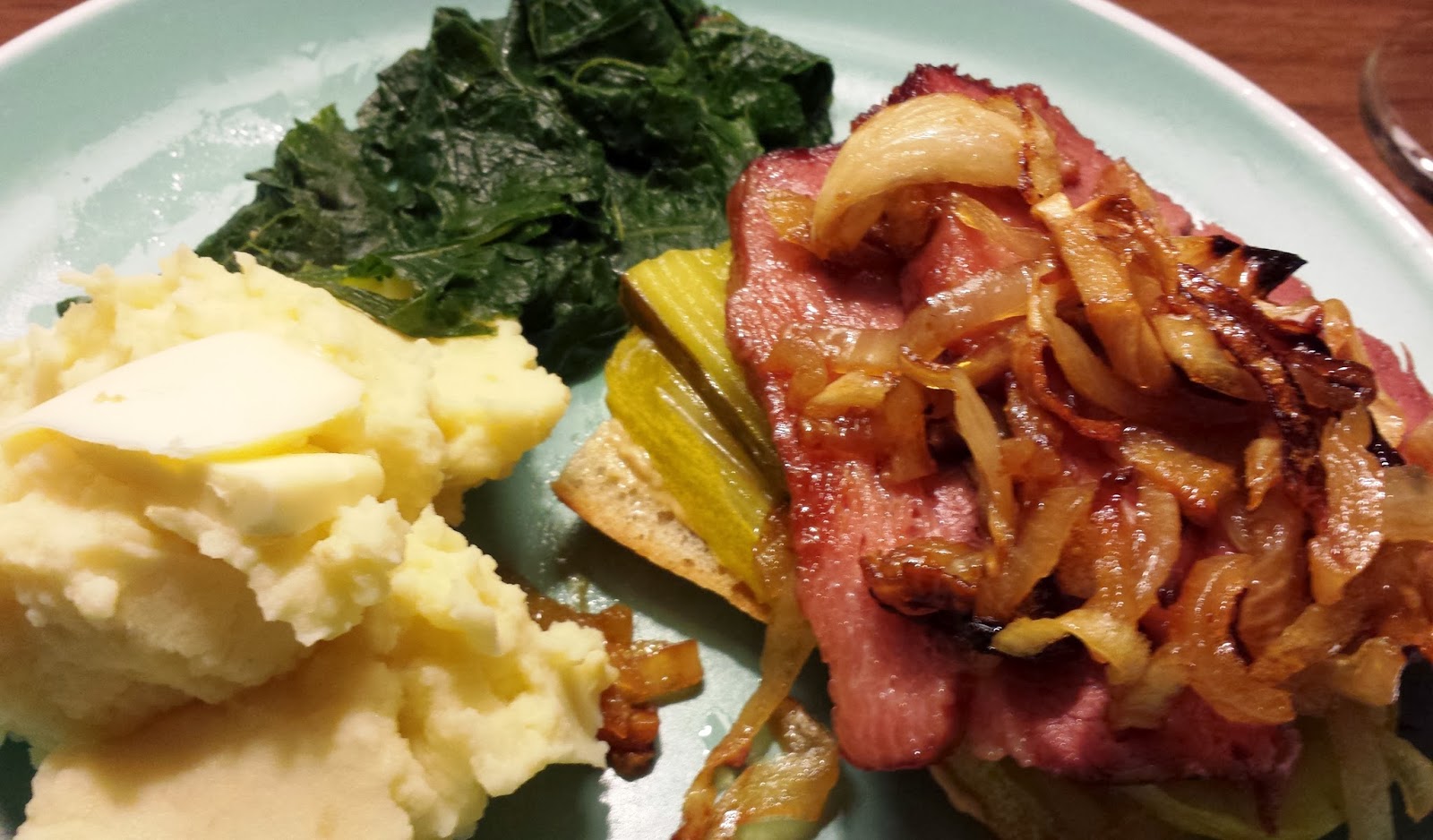
The book’s simple recipe for Sara's Pickled Brisket is suitable for a cut of corned beef anywhere between 2 and 4 pounds; mine was just more than 3 pounds, allowing for a substantial dinner for three and plenty of leftovers.

The meat is covered with cool water and a cup each of white vinegar and raw sugar, plus a small handful of peppercorns and nine bay leaves. I’m lucky to have a tree, so I plucked fresh leaves for the purpose.

After two hours of simmering, the corned beef was tender enough to be lifted by a fork but slide right off. The meat was transferred to a roasting pan, given a good scrub with several cloves of crushed garlic and allowed to rest and cool. Ideally, it should be refrigerated overnight and finished the next day. Since I prepped mine in the morning, I finished the following steps to serve it for dinner the same night.

Mound a pile of 3-4 thinly sliced onions on and around the meat, then drizzle on about ¾ cup of honey and 2 tablespoons canola oil. Place the roasting pan into a preheated 375 degree oven for about 45 minutes, occasionally stirring the onions, until the onions are tender and caramelized.

(Note: In my case, the onions were slow to brown. I removed the meat after 40 minutes and tented it with foil to avoid overcooking, then returned the roasting pan to the oven to give the onions more time to finish.)

The meat sliced easily and the finished dish was assembled on a rectangular serving platter. As if the meal was not rich enough, we served it with a mountain of buttery mashed potatoes and plain, practically penitent boiled greens.  We had enough leftovers to dice and add to hash for a second meal topped with lightly fried eggs, whose runny yolks created golden puddles to sweep up with bread.

Monday, June 3, 2013

Chef Ashley Christensen working on first book

The story first ran in INDY Week.

Ashley Christensen and Edward Lee at a Stir the Pot
event held September 2011 at Christensen's Raleigh home.
Ashley Christensen pre-ordered a copy of Smoke & Pickles, a book by her friend Edward Lee, so she could be among the first to read it.

“You’re immediately engaged based on what a great storyteller he is,” Christensen says of Lee, who she met a few years ago through the Southern Foodways Alliance. “He’s a brilliant writer. His food is beautiful, thoughtful and bold. Those are things that, in combination, create something very special.”

Christensen said she was struck by Lee’s honesty in sharing so many personal stories and how they shaped him as a chef. “As chefs and restaurateurs, you are always on display,” says Christensen, who has welcomed hundreds of strangers to her Raleigh home for fundraising events. “I believe the book will make a lot of people think differently about how they approach the process, about not keeping the public and readers at arm’s length.”

Christensen intends to use a similar approach with her first book. She hopes to sign with an agent this week, a crucial step in getting the project to a top publishing house.

“Ed's and my books will be very different, but I want to share stories as he does to show how my thought process works,” she says. “I learned to cook by throwing dinner parties. It will be based on how that can explode into other things we can make.”

Christensen has been working hard to document the recipes that dazzle diners at Poole’s, Beasley’s Chicken+Honey and Chuck’s. Some already have been featured in food magazines.

“Like Ed, my goal will not people telling people how to measure,” she says. “I want to teach them how to think about cooking, the history of how food got here and why the relationship between chefs, farmers and artisan providers is so important.”

Lee, a three-time runner-up for James Beard honors will be celebrated Wednesday evening by Chef Colin Bedford with a special dinner at Fearrington Village in Pittsboro. The event starts at 6 p.m. Tickets are $85, which includes dinner, a beer tasting, gratuity and a signed copy of Smoke & Pickles.