Thursday, October 9, 2014

Chef Greene debuts elegant fall menu for Herons at The Umstead


Just a few months after he returned to the kitchen as executive chef, Steven Deveraux Greene debuted his fall menu at Herons at the Umstead Hotel for a group of local food writers Wednesday evening. His stunning creations, partnered with a quartet of desserts from new Pastry Chef Evan Sheridan, left little doubt that he is up to the challenge of running one of the state's most elegant and acclaimed dining rooms.

Sommelier Hai Tran got the evening started outdoors on the expansive terrace with a round of fall-friendly drinks, including twists on classics like the Manhattan and the Dark and Stormy -- the latter of which, dubbed the Dark and Stormier, was an especially smooth sip. 

The Umstead's outstanding service was in evidence as suited servers deftly delivered platters of Greene's artfully plated tasting courses. Most are featured on the new harvest-themed fall menu, albeit in larger portions.

Greene said he was particularly pleased with this dish, which was served in a fantastical glass bowl that emphasized its spare beauty. An arrangement of king crab and grape gazpacho relish was doused with a delicate broth of vanilla scented Iberico ham broth poured from small tea pots.  (On the menu, the crab is replaced with Scottish langostines.)

Greene showed good humor with his Poussin Corn Dog, a savory bite of battered, deep-fried chicken set atop a dollop of truffled mustard and peppery yellow arugula blossoms. He said the dish dated back to his first stint at Heron's, before he became executive chef across the street at the stellar An Cuisines.

The beef tartare's bite of fresh horseradish was tempered with lemon confit and tarragon and polished to a glossy sheen with what was described as a beet-dashi veil. A round of buttery brioche cleverly concealed PB, FG and J -- a decadent blend of peanut butter, foie gras and muscadine jelly.

The Lobster Agnolotti was a pocket of squid ink pasta warmed in browned butter and served atop creamed sunchoke. The curiously named Beet Toast was revealed as a moist slice of sorghum bread with a wedge of roasted beet lacquered with a dressing that included vinegar infused with long-leaf pine needles gathered from the hotel grounds.

The showstopper of the evening was the still-warm Calvander Custard, in which Greene mellowed the aged, raw milk Chapel Hill Creamery cheese with more truffle and topped it with slivers of celery and cubes of roasted apple. Lucky guests congratulated Greene on the triumph, which should not be missed when choosing from the menu.


Four bite-sized desserts followed, starting with a creamy persimmon pudding framed with pine nut brittle, candy cap sabayon and date glaze.  It was accompanied by a single macaron shell garnished with a chocolate filled with a luscious calamansi citrus gel, a curl of pomegranate molasses and dusting of edible gold leaf.

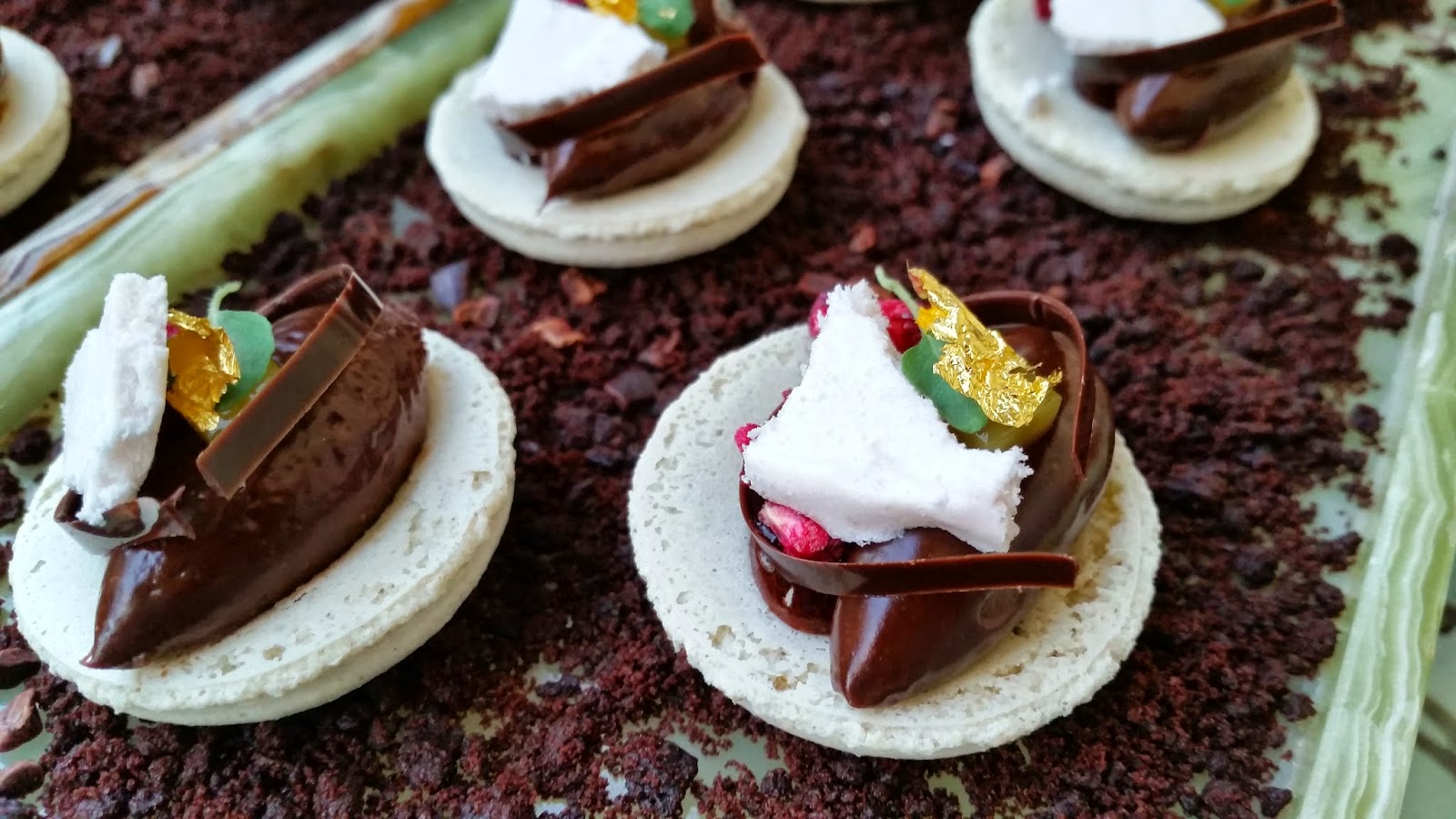


The tasting concluded with a creamy chestnut custard with fig jam and toasted milk, and the beautifully plated Autumnal Cake, an appealingly light square of pear cake with roasted pear and walnut powder. If you took your time and savored the latter in small spoonfuls, you were rewarded with the discovery of a golden scoop of caramelina mousse on the bottom.


Guests were sent home with a harvest basket filled with a pair of butternut squash and fresh herbs from the SAS Farm, a mini loaf of Autumnal Squash Bread, and Sheridan's recipe to recreate at home. 

Autumn Squash Bread
By Pastry Chef Evan Sheridan

4 oz/111g maple syrup
2.5 oz/75g sugar
1 whole egg
1.6 oz/46g vegetable oil
6.75 oz/190g pureed roasted butternut squash
1/4 tsp/2g baking soda
1/8th tsp/4g ground clove
1/8th tsp/4g nutmeg
1/8th tsp/4g fresh sage, minced
1/8th tsp/4g fresh rosemary, minced

Preheat oven to 350 degrees.

Cream the egg with the sugar, oil and maple syrup. Add in the roasted squash.

Sift the dry ingredients, then mix into the batter until just combined. Fold in the fresh minced herbs.

Bake in loaf pan coated with butter or cooking spray for 30-45 minutes or until the bread is firm on the top and an inserted toothpick comes out clean.

Little cookbooks, big results: Short Stack series has a Raleigh connection with Kaitlyn Goalen

Kaitlyn Goalen
(Indy Week photo by Jeremy M. Lange)
Increasingly, home cooks are forgoing expensive cookbooks in favor of finding recipes online or downloading interactive lessons to their e-readers. Why pay for milk, they reason, when they have free access to a highly productive cow?

Amid such frugal thinking, it may seem surprising that Short Stack—a collection of single-topic mini-cookbooks, handmade and stitched with peppermint-striped baker's string—would achieve success in the overstuffed culinary marketplace. These decidedly retro productions have charmed critics and attracted the participation of top cookbook writers and recipe developers.

Reviews have celebrated the creativity of New York City-based publisher Nick Fauchald, a former editor of Food & Wine, and the more than $92,000 the project quickly raised via Kickstarter. Interestingly, however, none of the ample praise has mentioned that Short Stack has roots in Raleigh.

Fauchald's co-founder and editor is Kaitlyn Goalen, who divides her time between Raleigh and Brooklyn. A former writer for Food & Wine and website Tasting Table, Goalen is the founder of Wild Yonder, a Raleigh-based foodcentric outdoor camp experience for adults. The 26-year-old has an even better reason for hanging around the capital city, however. She dates chef and restaurateur Ashley Christensen.

Goalen says she and Fauchald share a passion for vintage cookbooks, especially the giveaways that used to come with a bag of flour or the purchase of a new appliance in the 1940s and '50s. "Producing these small, beautiful, handmade books goes against everything in the industry," Goalen says. "But I think that's exactly why they click with people. You can look through one of these in 10 minutes and know what you want to make."

So far, Short Stack has published 10 titles, the most recent of which is Plums by Martha Holmberg. Previous topics include corn, honey, broccoli, sweet potatoes, grits, buttermilk, strawberries, tomatoes and eggs. Upcoming issues focus on apples and brown sugar.

While several volumes cover the same turf as the Savor the South series of single-topic cookbooks published by UNC Press, Short Stack is not Southern focused. And the slim collections include just 20 recipes each. "They are more like an author's love letter to a particular ingredient than a comprehensive cookbook," Goalen says.

Editions are sold online by subscription and for $14 each at select shops around the globe. Locally, they are sold at Parker and Otis in Durham.


Collection of Short Stack mini-cookbooks at Book Larder in Seattle
Short Stack already has a full roster of books scheduled for 2015 and is considering titles for 2016.

"We're trying to work on how to grow and keep the integrity of the project intact," Goalen says. "There have been times where we could have gone cheaper, or done things a little differently, but our success is validating."

With such a hectic work life, Goalen says she's glad to escape the city and enjoy a more relaxed pace in Raleigh.

"As someone who has only lived in giant cities before, I love it here," says the Los Angeles native. "People in New York seem burnt out, running on adrenaline and ambition. People I meet here are all incredibly engaged in something. They value the integrity of what they're doing and are passionate about collaborating.

"For me, having two communities feels really refreshing," she adds. "Some of our friends see us as having an essence of cool here in Raleigh. You know, cool people doing cool things at half the rent."

The mix of culturally savvy consumers and the natural beauty of North Carolina inspired Goalen to create Wild Yonder with friends Meredith Pittman and Heather Cook. The idea bubbled up while they were enjoying a few beers at the Wooden Nickel in Hillsborough.

"We thought about how great it would be to have a camp for grownups—with bourbon," she recalls with a laugh. "The next day we still were talking about it and decided to give it a shot."

Camps this season have featured games like Capture the Flask and a lesson in How to Survive a Zombie Apocalypse. "Instead of nasty camp food", we had an amazing meal prepared in advance by Cheetie Kumar of Garland, Goalen says. Live music was provided by Phil Cook of Megafaun and upscale s'mores were made with handcrafted Videri chocolate. A planned sleepover experience last weekend was canceled because of low ticket sales (tickets were $200 and up), but Goalen is optimistic about scheduling several next year. "The ultimate goal is to set up a hotel that will be a full-time project," she says. A location has not been selected but likely will be in or near the Triangle. "It would be a place where we could have programs, but also be a beautiful retreat."

SWEET POTATO–COCONUT MILK SOUP
Excerpted from Sweet Potatoes by Scott Hocker. Reprinted with permission of Short Stack.

This bold soup is so simple to make, it's nearly absurd. The recipe is inspired by what we in the United States know at many Thai restaurants as tom kha. As David Thompson notes in his superb cookbook Thai Food, this soup is more like a distant member of the tom gati school, a collection of soups that feature boiled coconut cream. It's fiery, sweet, sour and rich, from both the coconut and the sweet potatoes. I purée the soup for a silkier texture, even though doing so is inauthentic. But then so is using sweet potatoes.

Serves 4

2 small Thai or other hot chiles, stemmed
1 large shallot (about 4 oz.), peeled and thinly sliced
1 garlic clove, peeled
3 cilantro roots, scraped with the edge of a knife to remove dirt (cilantro roots are available at some farmers markets and Asian markets; if you can't find any, substitute 1/3 cup coarsely chopped thick cilantro stems)
2 cups vegetable or chicken stock
One 14-oz. can unsweetened coconut milk
1 medium sweet potato (about 10 oz.), peeled and cut into 1/2- to 1-inch pieces
Kosher salt
1 tsp. tightly packed light brown sugar
1 Tbsp plus 1 tsp. fish sauce
3 to 4 Tbsp. fresh lime juice (from about 2 limes)
¼ cup roughly chopped cilantro leaves

In a mortar, pound the Thai chiles, shallot, garlic and cilantro roots or stems together with a pestle until bruised (alternatively, pulse 3 to 4 times in a food processor).

In a large saucepan, bring the stock and coconut milk to a boil, then reduce to a simmer. Add the chile-garlic mixture, sweet potatoes and 3/4 tsp. of salt and cook, stirring occasionally, until the sweet potatoes are extremely soft, about 15 minutes.

Using a handheld immersion blender (or regular blender), purée the soup until it's smooth. Strain the soup through a fine-mesh sieve, pressing on the solids. Discard the solids and return the liquid to the saucepan. Bring to a simmer and add the brown sugar, fish sauce and lime juice. Adjust the seasonings, if needed; the flavor should be boldly sweet, salty and sour. Divide the soup among 4 bowls and garnish with cilantro leaves. Serve immediately.


This post first appeared in Indy Week

Tuesday, September 30, 2014

Bialys: Loaf catches the eye of Bon Appetit

The bialy from Loaf has earned national appreciation. - PHOTO BY JUSTIN COOK
Indy Week photo of bialys from Loaf
n Durham by Justin Cook
This post first appeared in Indy Week on Sept. 24.
In my New Jersey youth, bialys were the sad, dusty cousin of the chewy bagel. Crowned with poppy seeds or the sticky goodness of not quite burnt onions, fresh-baked bagels released a pleasing genie-like waft of steam when torn. They achieved their full, God-given glory when spread with cream cheese and topped with lox and onion.

But the bialy? It did not receive the ritualistic schvitz bath in simmering water before baking. Even with its pocket full of melted onion, it sat forlorn on the plate, looking every bit like the confused Eastern European immigrant it still was. The only one in our house who appreciated its humility was my father, a child of the Depression who grew up knowing that what wasn't eaten today would be eaten stale tomorrow.
Thanks to artisan baking communities from Brooklyn to Berkeley, the bialy is enjoying a resurgence. A recent story in Huffington Post declared that today's bialy is "better than any bagel you've ever had."
That's a big boast, but Bon Appetit apparently agrees. The magazine, which bestows sales-boosting credibility to a handful of locally produced goods each month, featured a full-page beauty shot of bialys from Loaf Bakery in Durham in its September issue.
Manager Mary Turner recalls when Andrew Knowlton,Bon Appetit's globetrotting bon vivant, came into the shop last April with Mark Overbay of Big Spoon Roasters. Not long after purchasing a bialy, Knowlton posted a photo of it, stating: "I like finding a bialy outside of its native habitat. This was a good one."
"We recognized him, of course, and it was a thrill to see the post," says Turner, who tucks trays of fresh bialys in Loaf's temptation-filled display cases each Tuesday, Thursday and Saturday morning. "A few days later, he asked us to send a box of them to his office to be photographed."
Co-owner Ron Graff first experienced bialys in New Jersey while earning a graduate degree in toxicology at Rutgers. About a year after Loaf opened in November 2011, they added bialys as part of their savory breakfast offerings.
"We thought about bagels but didn't want to mess with boiling" the dough, Graff says. "Initially people weren't sure what they were, but that happens a lot. They either haven't seen it before or don't know how to pronounce it. 'Oniontastic' was one of the words people used."
Graff is very much a traditionalist, so those looking for funky tweaks will have to look elsewhere. "I would hate for someone to have a bialy of ours and then go to New York and see that we were doing something completely messed up," he says.
Long the butt of sour humor—the scheming Max Bialystock of Mel Brooks' The Producers takes his name from the Polish town where bialys were first made—bialys are no longer something to laugh at.
Fulton Forde of Boulted Bread in downtown Raleigh also takes bialy making seriously. He has to, given that customers start lining up soon after the shop opens at 7 a.m. to grab a traditional bialy or his "Southern" version, which features country ham and cheddar. It sounds like something that borders on blasphemy, but it's just too darn good to complain.
Boulted Bread makes bialys every morning and keeps a batch of dough ready in case anyone comes in desperate for a fix. As at Loaf, they only take about 12 minutes to bake. Boulted's version, however, has a higher whole wheat content that lends an appealingly nutty flavor.
"We bake a lot of fancy things, but not everyone wants to eat croissants and sweets all the time," says Forde, who made bialys for several years at Asheville's acclaimed Farm & Sparrow Bakery. "These aren't entirely typical, but we do have people who come in for them every day."
Barrett Jenkins is among them. He prefers the traditional bialy and nibbles around the circumference to save the oniony center, which glistens with fruity olive oil, to savor "like dessert." Matt Wickwire, who painted the mural on their building, prefers the ham and cheese version. "I usually have a biscuit for breakfast, but this is so much better," he says.

Try A Bialy in Something Sweet for Rosh Hashana

While the bialy is not typically a food enjoyed as part of the Rosh Hashana observance—the Jewish New Year officially begins today at sunset—round foods are symbolic of unity, wholeness and eternity, good things to ponder when observant Jews ask to have their names once again written in the Book of Life.
Foods consumed during Rosh Hashana typically include apples and honey, which are intended as harbingers of a sweet year ahead. So this year, why not live large? Stop by Loaf Bakery and Boulted Bread for a fresh warm bialy, dunk it in some honey or add a dollop of apple butter. Whether you observe or not, it's a great way to start the day.

Tuesday, September 16, 2014

Cooking old-school with fire can teach much about modern foodways

Food historian Paula Marcoux will talk about how paying attention to historic cooking can improve contemporary home cooking at 7pm Wednesday at Flyleaf Books in Chapel Hill. The event is the season opening meeting of Culinary Historians of Piedmont North Carolina (CHOPNC). Admission is free and Marcoux will sign copies of her book, Cooking With Fire: From Roasting on a Spit to Baking in a Tannur, Rediscovered Techniques and Recipes That Capture the Flavors of Wood-Fired Cooking. 

After a long humid summer, we all crave fall. Leaves already are beginning to change color and loosen. 

Pine straw soon will follow. So when those needles carpet your yard, do what Paula Marcoux does: Set them on fire.

“Some people are wary of digging a fire pit or cooking in the fireplace, but everyone seems to get the idea of cooking mussels with pine straw," says Marcoux, a food historian who shares her passion for primal cooking methods in her book,Cooking With Fire: From Roasting on a Spit to Baking in a Tannur, Rediscovered Techniques and Recipes that Capture the Flavors of Wood-Fired Cooking (Storey Publishing).

Pine-Needle Mussels from Paula Marcoux's website.
Marcoux made the dramatic meal for an episode of the aptly named Man Food Fire on the Cooking Channel. She's also made it several times during her book tour and recommends it as an easy way for newbies to try cooking with live fire.

Many people embrace it because there are no tools needed," says Marcoux, whose book includes step-by-step photos how to arrange the mussels and pine straw. "A lot of people say they want to jump right in and build an oven. I try to back them off from that and try less expensive or labor intensive methods. People with fireplaces have huge opportunities to try a lot of the recipes without making big changes or an investment."

Marcoux just led an extraordinary fireplace cooking presentation at Monticello, the Virginia estate of Thomas Jefferson. Jefferson was a lover of fine food and wine who is credited for introducing many European delicacies and cooking methods to colonial America. The original kitchen fireplace remains at the historic site but is not often used.

"One of the barriers is that no one wants to be the one to burn it down," she jokes. "But it's a really safe arrangement. With ordinary precautions, they can have a very vibrant exhibit there. I'm happy to know that I was a small part in possibly opening this up in the future."

Marcoux worked on the menu with Dr. Leni Sorensen, a fellow scholar who is cooking her way through The Virginia Housewife: or, Methodical Cook by Mary Randolph. First published in 1838, it is generally recognized as the first truly American cookbook. She followed its directions to prepare a sumptuous meal of roast leg of lamb, okra and tomatoes, sweet potatoes on a griddle and burnt cream, the latter being an Americanized crème brulee.

"It was an amazing, awe-inspiring honor to cook in the actual Monticello kitchen," she says. "It's a very simple hearth, and they also have a stew stove with air blowing up beneath it. It's a much more precise way of cooking and keeping temperature under control. I made a butter sauce on it, something you have to pay attention to."

While Marcoux cooks with an eye on history, Cooking With Fire is written for the modern cook who wants to broaden their understanding of cooking over an open fire. 

"It's surprised me how many people who have told me that they built a fire pit in their yard – and that they view it as a really nice feature," Marcoux says. "I think there is renewed interest because many chefs and bakers are going back to cooking with wood fuel. The flavor can't be matched any other way."

Marcoux is strongly opposed to cooking with a gas grill. "Using them always reminds me how much I hate them," she says. "Even the expensive ones just don't get hot enough. And if you use the lid, it steams instead of grills. The crappiest little hibachi and coal is better." 

If you don't have a hibachi and aren't keen on mussels, Marcoux suggests banking dry wood in an old kettle-style grill to get a taste of the live-fire cooking experience.

"They're not made for such high heat, so it will burn out" she warns. "But if you keep watch, people are always throwing away parts of old grills. I have quite a few, myself. I also collect heavy cast iron pans from people who say they are too heavy to use. If you don't cook directly on a grate, there's nothing better than a heavy cast iron pan."

And there's always your fireplace – or a friend's fireplace, if your home does not have one. "No one thinks to cook in their fireplace, but it won't destroy it to grill a steak or roast a chicken," she says. "You can learn quite a bit by cooking the way they did hundreds of years ago."

Pine-Needle Mussels
Excerpted from “Cooking with Fire” by Paula Marcoux, photography by Keller + Keller, used with permission from Storey Publishing.

In October, the pitch pines and white pines around our house drop a beautiful puffy mat of russet needles. It takes but a few minutes to gather up the pile needed to have this kind of fun. This is an irresistible introduction for newbies of any age to both cooking with fire and eating shellfish.

About 4 or 5 pounds of fresh mussels in the shell

6 to 10 servings, as an appetizer

1. Gather 1/2 to 1 bushel nice dry pine needles.

2. We like to set this up directly on an outdoor wooden table, but you can use a large board (say 3 by 3 feet) or a very flat large stone. Be aware that you will leave a pretty good scorching on whatever surface you select. Also look around before you start to make sure that you will not inadvertently set something else on fire; have a bucket of water handy just in case.

3. Place something small and stable in the middle of the board; a quarter of a brick, a small oblong stone, a half of a potato, cut side down, a small cube of stale bread . . . Arrange the mussels around it, leaning against the supporting object, with their pointy ends sticking upward. Continue arranging all the mussels in a concentric manner. Many hands make quick work and add to the fun.

4. Now let everyone scatter the pine needles evenly, and as deeply as possible, over the top of the mussels. Give a brief safety lecture, then take a single coal from whatever fire you have burning nearby and deposit it deep in the mountain of pine needles, directly on top of the little support in the middle. (If for some reason you don’t have a fire already burning somewhere, just use a match.) Stand back; these babies really go up.

5. That’s it. When the fire dies down, within the smoking ruins lies a tasty appetizer. Resiny-smoky, briny, delicious. I once tried offering toast and remoulade sauce as accompaniments, but was soundly rebuffed with cries of “they’re too good alone!”

6. If for some reason there’s a cool spot in the fire and some of the mussels don’t open, gather them up and rearrange them with new pine needles for a quick encore pyre.


Monday, August 25, 2014

Hadassah speaker to describe Jewish cooking around the world, from generation to generation


Greta Schiffman will be the guest speaker for the Greater Wake County Chapter of Hadassah at an event to celebrate its new community cookbook: l’dor v’dor: from biscuits to briskets. Greta will talk about Jewish food around the world at 7 p.m. Sept. 9 at Temple Beth Or, 5315 Creedmoor Road, Raleigh. The event is free and light refreshments from the cookbook will be provided. 
Copies of the cookbook, which features more than 300 recipes from members, will be sold for $20 each. Proceeds benefit Hadassah Hospitals and vital medical research underway in Israel.


Some people think cooking fresh food for their family is a drag. Not Greta Schiffman.

“Cooking has always been a joy and an adventure,” says Greta, a retired kosher caterer who has lived and cooked around the world. “Also, why go out when I can prepare meals better with better ingredients?”

It wasn’t always like that, however. Greta and her sister both didn’t start cooking until they left home as their mother was a bit territorial about her kitchen. “She had a hard time sharing,” Greta says. “She wasn’t a gourmet cook, but she was a phenomenal baker. I think she felt that if she taught us to bake we wouldn’t ask her to help us with our baking.”

Greta Schiffman
Her mother’s baked goods were well known in their hometown of Poughkeepsie, located in upstate New York near the Culinary Institute of America. In fact, when their synagogue would have bake sales, most of her contributions were sold before people ever got through the door.

“Her rugelach and especially her yeast cakes were very good,” she recalls. “She was an ethnic cook who learned from her mother, who was Russian. They used to put up yeast cakes for the Sabbath. I remember that, those yeast cakes would be sitting Thursday night on the radiator when I was a little girl.”

Greta, a former public school teacher, became avid about taking cooking classes, often from chefs at top restaurants.  She and her husband, Saul, enjoyed entertaining, which gave her a chance to show off new skills. People often begged for her recipes, saying her food was better than anything they could buy in area restaurants and shops.

As Greta’s skill and confidence grew, she chaired cooking committees for her synagogue and civic organizations. It became a constant in her life when, as her husband’s career advanced, they moved every few years.

In the 1980s, when the Schiffmans lived in Tampa, Fla., she quit teaching and started baking and cooking for friends at her new temple. Before long, she partnered with a woman to create Simply Delicious, a kosher catering business. The start-up was flourishing when Saul was transferred to Japan.

“I told him he’s ruining my life,” quips Greta, who soon found work teaching English to women through Western cooking classes. “I learned a lot about Japanese cooking and traditional ikebana floral arranging, but all they wanted to know was how we cook and entertain in the US.”

When they returned to the states, the Schiffmans moved to Raleigh. She worked part-time baking for a small catering business that grew into the Tuxedo Café at the old North Hills shopping center.  When the business was sold, she started baking at the Irregardless Café.

Raleigh remained their base while Saul’s career took them back to Japan and later to Australia. They are both retired now.

“I’ve always found cooking very therapeutic, especially baking,” she says. “But I’ve worn out my hands. I’ve had two hand operations. Also, my husband was tired of his car always smelling like food.”

Greta was always protective of her recipes while working as a caterer, but she has shared several of her best that are included in l’dor v’dor: from biscuits to briskets, the new community cookbook published by the Greater Wake County Chapter of Hadassah.

“I am happy to be part of it,” says Greta, whose three daughters are excellent cooks like their mother. “It’s a really wonderful thing to add l’dor v’dor to my collection of cookbooks. I have books from different Jewish organizations, including National Hadassah, and one from my temple in Poughkeepsie from many years ago that I still use all the time.

“Someone just asked me about getting a copy of l’dor v’dor, and they’re not even Jewish. They wanted to have a really good exposure to Jewish cooking,” she adds. “It’s good to have so many great Jewish recipes to treasure and share.”

If you are unable to attend the Sept. 9 event but would like to order copies of l'dor v'dor: from biscuits to briskets at $20 each, send a check made out to Greater Wake County Chapter of Hadassah to: Rita Kessler, 10504 Parsley Court, Raleigh 27614. For information about our Hadassah chapter, please visit our website or follow us on Facebook.

Thursday, August 21, 2014

Weekend: Slingshot opens a morning hangout

This post first appeared in Indy Week.
Rain fell steadily the Friday night that Slingshot Coffee owner Jenny Bonchak welcomed fans and friends to her new Raleigh headquarters at 1420 N. Brookside Drive. She and husband Jonathan Bonchak couldn't show off the comfy sofa and chairs purchased for its new outdoor coffee shop, Weekend, but no one seemed to care.
Jenny Bonchak, the founder and CEO of Slingshot,
makes a pour over. (Indy Week photos by Jeremy M. Lange)
Supporters gladly crowded into the 1,000-square foot production room and gamely stood under a canopy of trees on the new patio to admire the sylvan view of a stretch of Crabtree Creek. They simply were too busy enjoying themselves, drinking coffee and beer, nibbling pork or vegan barbecue sandwiches, and listening to Stu McLamb of The Love Language perform a solo set.
The party is over, but the coffee continues to flow. The aptly named Weekend is open from 8 a.m. to 2 p.m. Saturdays and Sundays. Patrons appreciate the opportunity to have bean options and hot pour-over coffee made by Jonathan, who works for Counter Culture Coffee in Durham. Jenny pours cold Slinghot from a series of taps topped with actual slingshots.
"This is a chance for Jonathan and I to do something we've dreamed about for years—standing beside each other, making coffee in a coffee bar. Our coffee bar," she says.
In the coming weeks, Weekend will feature new menu items, such as herbal infusions and granita-like coffee slushies. They also serve baked goods from Yellow Dog Bakery, their North Person neighbor, including scones and Pop-Tart-inspired pastries.
Bonchak started brewing Slingshot two years ago in a now-closed restaurant during its off hours. A few months later, she moved to a 150-square-foot production room inside Oak City Cycling. The new location, which she thinks will also allow for future growth, was made possible by the company's first significant investor: John Replogle, president and CEO of Seventh Generation, a maker of environmentally friendly household products.
A customer enjoys a leisurely
sip on 
Weekend's patio.
"It's been amazing to have someone like that who not only is providing resources, but is providing a sounding board for me to talk through things," Bonchak says. "With his advice, I really feel like we're able to take a huge step forward."
When Bonchak launched Slingshot just two years ago, she would leave her day job and work through the night to bottle one batch and start brewing another. As a Valentine's Day gift to herself, she quit that job on Feb. 14. She now has three part-time employees, including one in Atlanta, and distributes Slingshot to retailers from Pennsylvania to Florida.
For this venture, Bonchak knows that her spouse is more than the average supportive husband. "You don't win the Brewer's Cup regionals twice in a row, and place at nationals, unless you really love making the very best coffee for people," she says with pride. "It's great to be able to do all this side by side."
The Bonchaks view Weekend's comfortable setting as an extension of their own nearby home. It's also pet friendly, with water bowls and a jar of dog biscuits next to the station with cream and simple syrup.
"Frank the beagle wouldn't have it any other way," Bonchak says of the couple's gregarious pup, who has his own Twitter account. "We love to be outside and entertain with friends, and we wanted the same feel for Weekend. We hope people will want to hang out here, enjoy some coffee, read the paper and just unwind."
Hannah Elmore stopped by with her husband, Jack, and their 2-month-old son, Roy, on their way to the State Farmer's Market. They got two coffees and a bottle of chilled Cascara Tea to go, along with a pair of Slingshot T-shirts. "We follow Slingshot on Instagram and were so excited when we heard Weekend was open," she says. "We love great coffee, so we'll definitely be back."

Thursday, August 14, 2014

Downtown Raleigh Restaurant Week returns

Raleigh restaurant lovers are counting the days until the start of Downtown Raleigh Restaurant Week, Aug. 18-24. That’s #DRRW, for those of you inclined to share your dining experiences online.

Forty eateries have signed on this year, including some of the Capital City’s best known and most upscale establishments and a few newcomers. Prix fixe menus offer flexible three-course dinners for $20 or $30, varying by location, and generally include vegetarian choices. Optional beer and wine pairings also are available.

Reservations are strongly recommended as these bargains tend to make busy restaurants even busier. Not all participants have their menus posted yet but visit the restaurant link of DRRW’s website for contact information.

Among the best deals for the $20 dinners can be found in the hopping Glenwood South neighborhood. At 518 West, Chef Serge Falcoz-Vigne will present shrimp polenta, eggplant parmesan or pasta saltimbocca. Around the corner, the globally inspired menu at Chef Steve Day’s Plates Neighborhood Kitchen also satisfies with choices like smoked duck breast carbonara and homey chicken and dumplings, as well as the irresistible sticky toffee pudding for dessert.

The Oakz, one of the newest eateries on the list, serves a changing a menu that features different US regional cuisines. The father-and-daughter duo of Ira Freedman and Jaclyn Sterritt offer both $20 and $30 options. The latter includes such temptations as fried duck and waffles or seared scallops with fried sweet corn polenta and mango relish.

Options abound in the $30 category. Always wanted to dine at Second Empire, one of Raleigh’s top special occasion locations? Here’s your chance to pull up a chair in the historic house located steps from the State Capitol, where you’ll experience Chef Daniel Shurr’s luxe approach with the “off the hook” daily catch or roasted Springer Farms chicken.

The hip hospitality and authentic Laotian food served at Bida Manda at Moore Square make it one of Raleigh’s most popular destination eateries. Chef Lon Bounsanga presents challenges for diners at every course: crispy pork belly soup or green papaya salad? Seafood pad Thai or fried North Carolina whole fish? Don’t fret. It’s all good.

ORO Restaurant in the PNC Building focuses on shareable tapas in a glitzy setting that transfix people passing by its tall windows. Start with smoky ribs or a cup of yellow tomato soup before building up to a New York strip doused with a bok choy peppercorn sauce or grilled salmon with jicama citrus salad and passion fruit sauce.

In addition to participating in the $20/$30 dinner deals, two restaurants are offering a $65 Elite Experience with five-course meals and wine pairings. Both feature Italian fare with four fourth-course options.

Jimmy V’s Osteria + Bar is located in the ground level of the Sheraton Hotel on Fayetteville Street, across from the Raleigh Convention Center. Chef Michael Kuilan’s modern Italian-American menu is meant to capture the spirit of its namesake, the late NC State University basketball coach Jim Valvano.  Choices include lobster mac & cheese and short rib ragout.

Tuscan Blu is a DRRW stalwart located in the Warehouse District. Chef Maurizio Privilegi’s house-made pastas star in a third-course trio of fiocchi (“purses” filled with goat cheese and pear) and oversized ravioli. Main course options include braised ossobuco over risotto and branzino (baked sea bass).