Showing posts with label strawberries. Show all posts

Thursday, February 20, 2014

Strawberry balsamic meringues are a welcome taste of summer


Raleigh’s harsh winter, combined with early signs of spring in our garden, has sent my taste buds in search of the reassuring flavors of summer. Since I preserve fruits in jams and jellies at peak season, this allows me a chance to bring some sunshine into my kitchen on even the dreariest of days.

After a blast of snow and ice that all but shut down the Triangle for three days, I found myself craving the satisfying crunch of meringue cookies. Not just any meringues, but ones swirled with the jammy goodness of jewel-toned strawberries. To keep them from being overly sweet, I tempered a few spoonfuls of jam with a splash of balsamic vinegar.

My first attempt with a dud. Although they were dutifully eaten, they were gummy, victims of excess moisture from snow and ice. Lesson learned: Do not attempt meringues on snowy, rainy or otherwise high moisture days.

I also tried a different “cook and forget” method, in which the cookies were supposed to slowly dry – in a few hours or overnight – in an oven that had been preheated and then turned off as soon as the cookie trays were tucked in. This may work in electric ovens, but my gas stove did not hold enough heat for this magical transformation to occur.

A few days later, after rising temps and sunshine cleared our neighborhood, I tried again. I went back to my standard practice of slow cooking meringues for about 90 minutes, but decided to leave them in the closed oven for a couple of hours for good measure. The resulting cookies were crisp on the outside with meltingly tender insides. They were irresistibly delicious, lasting just long enough to snap a few photos.

Strawberry Balsamic Meringues

Makes about two dozen cookies. Do not attempt when the weather is damp.

3 eggs whites at room temperature
1 teaspoon cream of tartar
2/3 cup granulated sugar
½ teaspoon strawberry extract
2½ tablespoons strawberry jam
1 teaspoon balsamic vinegar

Preheat the oven to 225 degrees and line two baking sheets with parchment paper. Set aside.

Place strawberry jam and balsamic vinegar in a small sauce pan over low heat. Warm just enough to combine, mashing on any large chunks of fruit to break them up. Set aside.

In the bowl of an electric mixer, beat egg whites until foamy. Add the cream of tartar and beat until fluffy but not dry. Add the sugar gradually, about one tablespoon at a time. When half of the sugar has been added, add the strawberry extract. Continue beating and gradually adding sugar until all sugar is dissolved and the meringue is glossy and firm.

Gently drizzle the cooled strawberry jam-balsamic vinegar mixture over the meringue. Using a wide rubber spatula, fold lightly into the meringue. Do not fully combine; the goal is to leave pinks streaks. Be careful to not deflate the meringue.

Using two teaspoons, lightly push a generous spoonful of meringue onto the lined baking sheets, leaving an inch of space between cookies. (Meringues also can be decoratively piped.)

Place baking sheets in the preheated oven and set the timer for 90 minutes. Turn off heat and leave the cookies (undisturbed) in the oven for at least two hours and up to overnight, or until cookies are crisp and dry.

Meringues are best eaten the same day but may be stored in an airtight container for up to three days.


Sunday, May 13, 2012

A toast to non-traditional preserves

Paul Virant has a message for home preservers: He wants you to see an empty canning jar as more than a mere vessel for sweet spreads. And he wants you to get out of the box.

“Too many people think they’ve got to buy those boxes of pectin to make jams and jellies, but they don’t,” said Virant, author of The Preservation Kitchen: The Craft of Making and Cooking with Pickles, Preserves, and Aigre-doux (Ten Speed Press) and chef at Chicago’s Vie Restaurant. Substitute patience and great ingredients, he said, and the results will be delicious.

If you don't have a dehydrator, slow roast
strawberries to intensify their flavor
Virant is not overly concerned about creating fruity slathers for toast, though he does offer a number of deeply flavored jams – such as the intense Dehydrated Strawberry, which brings undeniable luster to bread and muffins. Most of his preserving recipes come with tips for how to apply them to everything from cocktails to main courses. His Beer Jam, for example, made with stout and spices (see recipe below), results in a loose jelly that he uses to both punch up a Manhattan and glaze tender beef cheeks.

A batch made with North Carolina’s Duck-Rabbit Milk Stout produced a heady brew that that turned a basic grilled burger into a burnished specialty you’d pay way too much for at a restaurant. It also was great on roast chicken and added an appealing varnish to grilled tofu. Rhubarb Beer jam, which I made with Blue Moon, is an ideal accompaniment to a cheese and charcuterie plate. Virant uses it to jazz up a Normandy, a cocktail featuring Calvados.

Grilled burger glazed with Beer Jam and
topped with gorgonzola and balsamic onions
Using preserved foods in new ways is the main takeaway Virant wants readers to experience. “My style has developed over time to a point where preserves are really incorporated into the food, into sauces, reductions, gastriques, glazes. It’s a major part of the dish, not an accompaniment.”

If you prefer the reliability of added pectin, Virant doesn’t mind. He sometimes adds an all-natural dried apple powder made by Patisfrance, and similar products are available online and at natural food markets. He also provides directions for homemade pectin, which is essentially a lightly-set apple jelly. He uses this in several recipes, but most rely on a long rolling boil and a candy thermometer to establish the desired degree of jelling. 

This is especially true of the recipes that start with a slow maceration, a minimum of overnight or up to a week. This allows busy canners to set fruit in sugar at its peak, condense it for easy refrigerator storage and finish the processing later.

“The nice thing about the maceration method is that you’re actually preserving the fruit before you can,” Virant explained. “For example, you have these incredible ripe blackberries that could spoil before you have time to make jam. It’s an easy thing to bring it to a boil and then refrigerate. You preserve the integrity of the freshness and instead of waiting a few days as it decomposes.”

While his methods and recipes may seem novel, Virant got into canning the way many people do – by cooking with his grandmothers.

“It’s a life’s passion. I have more memories of making pies and cakes, but my grandmother on my mother’s side was really involved in canning,” he said. “For me, the appeal is a lot like making bread or beer. You’re dealing with a living microbe. There’s that element of transforming ingredients and waiting to see what it will be like. Finally opening a pickle or a jar of jam, it’s rewarding.”

Virant’s interest in canning and preserving has an important place in his overall culinary expression. Indeed, it’s proved especially valuable at the restaurant, where preserving excess produce both reduces waste and brings a dash of depth or acidity to balance a dish.

“I’ve always had the problem of going to a farmer’s market and buying more than I need,” he confessed with a laugh. “It’s like the old saying: ‘Eat what you can, and can what you can’t.’”

Golden wheat beer tints savory Rhubarb Beer Jam 
Currently, Virant is obsessed with spring onions, which are just arriving at Chicago farmer’s markets. “There’s a recipe in the book for Smoked and Pickled Spring Onions that I really like. It’s a bit labor intensive, but it’s really worth it.” His also notes how to add the mix into a relish he uses to top chicken-fried steak.

Virant also is on a mission to master pickled okra. “We used a lot of smoked okra, but pickling it is not easy,” he said. “I’ve done it for years but I don’t feel like I’m quite there yet.”

The arrival of spring gives virtually everything in Virant’s gaze potential for preserving and repurposing in the restaurant. He wants home cooks to feel the same way.

“We’re using a lot of rhubarb now, and ramps,” Virant said. “It’s important to build experience before you experiment. If you follow recipes from good sources, you’ll learn pretty quickly how things should look and react. It’s usually pretty obvious if something doesn’t work.”

If you open a canning jar and detect an off odor, or anything about the product looks odd, Virant advised, pitch it. It’s far better to lose a batch than risk making anyone sick.

That said, he added that creative canners should not let such fears hold them back. “Coming up with something new is fun and satisfying,” he said. “You just never know where it will take you.”

Below find a corrected version of the Beer Jam recipe included in The Preservation Kitchen. The first-edition publication inadvertently omitted when to add pectin in the directions (highlighted below). I skipped the star anise as it’s my Voldemort of spices. The result was a bold and full-bodied glaze.

Beer Jam
Reprinted with permission from The Preservation Kitchen: The Craft of Making and Cooking with Pickles, Preserves, and Aigre-doux by Paul Virant with Kate Leahy, copyright © 2012. Published by Ten Speed Press, a division of Random House, Inc.

Yield: 6 half-pint jars, plus 1 (4-ounce) jar

Ingredient
Volume
Ounces
Grams
Percent
Stout beer
4 (12-ounce) bottles
3 pounds 3 ounces
1,361 grams
55%
Sugar
4 2/3 cups
2 pounds
907 grams
345%
Lemon, juiced
1
1 ounce
28 grams
1%
Vanilla beans, split
2
–
–
–
Allspice berries
10
–
–
–
Cloves
3
–
–
–
Star anise
2
–
–
–
Orange zest
1 large strip
–
–
–
Pectin (page 000)
1 cup
8 ounces
227 grams
9%

1. In a large, heavy-bottomed pot over high heat, bring the beer, sugar, lemon juice, vanilla beans, allspice berries, cloves, star anise, and orange juice to a boil. Remove from the heat, transfer to a storage container, and refrigerate overnight or up to 5 days.

2. Strain the liquid and save the vanilla beans for another use. Pour into a large, wide pot, stir in the pectin, and bring to a boil over high heat—be careful that the beer doesn’t boil over. Cook, stirring occasionally, until the mixture reaches about 215˚F and has the texture of light syrup, 25-35 minutes.

3. Scald 6 half-pint jars and one (4-ounce) jar. (To scald, using tongs put the jars into a large pot of simmering water fitted with a rack—you will use this pot to process the jars.) Meanwhile, soak the lids in a pan of hot water to soften the rubber seal. Right before filling, put the jars on the counter.

4. Transfer the jam to a heat-proof pitcher and pour into the jars, leaving a ½-inch space from the rim. (Depending on how much you reduced the jam, you may not need the small jar.) Wipe the rims with a clean towel, seal with the lids, then screw on the bands until snug but not tight.

5. Place the jars in the pot with the rack and add enough water to cover the jars by about 1 inch. Bring the water to a boil and process the jars for 10 minutes (start the timer when the water reaches a boil). Remove the jars from the water and cool completely.

Sunday, April 15, 2012

The first bloom of spring canning

To make room for the abundance to come, I have been faithfully working down the contents of my canning closet and sharing jars of last season's excess with friends and neighbors. I have been scouring recipes books and searching online for something new and different for my first batch. Of course I'd use strawberries - but what else?

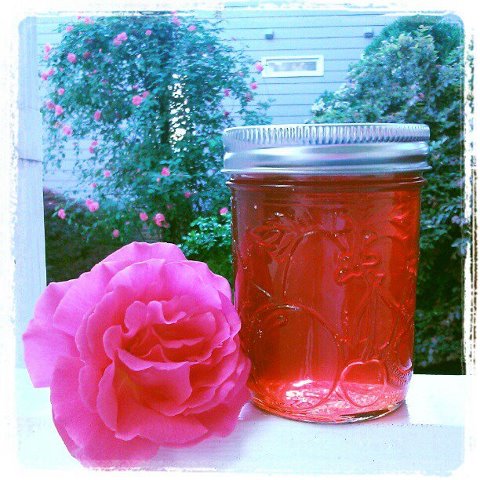
I considered the heat of chiles, the sweet bite of balsamic vinegar, shreds of bright green spring basil. Then, with an appeal as enticing as its heady aroma, it hit me: rose petals.

We have a lovely rose bush that was planted years ago at the end of our driveway to mask an abandoned basketball pole, which itself is planted in an absurd amount of concrete. Tim decided to wrap the pole in black mesh and set about training the vines to climb. It resisted at first but is now a bona fide showstopper.

Its heavily perfumed blooms never last inside - the petals usually shrug off in a day -- but this made them ideal for a rose water infusion, which in turn he made a fine base for strawberry juice. It was a two-day process that likely could be condensed, but it was time well spent.


You'll need a jelly bag, an inexpensive and wise investment if you plan to make jelly or syrup more than once. If you don't have one - or have done such a good job of putting it away that you can't find it - you can jerry-rig one from a cheesecloth-lined chinois or colander suspended over a large measuring cup or mixing bowl. I prefer a measuring cup as it's encouraging to watch it fill.

Only use roses from a trusted source where you are certain they have not been treated with insecticide. Choose large, open blooms that pull loose with little effort. Be sure to inspect well for blemishes and travellers. My bowlful had two crawling visitors that I returned to the wilds of my side porch.

This recipe will produce enough juice for two batches of jelly, which eventually follows the basic directions found on the yellow box of Sure-Jel pectin. Combining to save time could result in a doubt batch of disappointment that will never set properly.

Strawberry Rose Petal Infusion
12-15 rose blossoms
6 cups water
3 tbsp. fresh lemon juice, divided
4 1/2 cup whole strawberries

Lightly pull petals from rose heads and place in water-filled pot. Bring to a boil then reduce heat and simmer, lightly covered, for about 20 minutes. The result should be fragrant, rose-tinted water with color-drained petals that look like wet tissue paper. Move pot off heat, cover and steep 30 minutes.

While mix is steeping, clean and trim strawberries. I used a food processor to coarsely chop the berries. Add remaining lemon juice and pulse until still chunky but juicy. It should measure about 3 cups.

Add mashed strawberries to rose water and return mix to a boil. Reduce heat and simmer, lightly covered, about 10 minutes. Let mix cool completely then cover and store overnight in the refrigerator.

Day 2
1 large lemon, juiced
1/2 cup white wine
2 yellow boxes Sure-Jel pectin
9 cups sugar, divided
1 tsp. butter
12 8-ounce jelly jars, or equivalent mix of sizes

Remove strawberry-rose mix from refrigerator and leave on counter until contents are at room temperature. Carefully transfer to jelly bag or cheesecloth-lined colander over a large measuring cup or bowl to catch juice. Resist the urge to squeeze the bag or press the contents to speed the process as it will release residue that will cloud the jelly.

Allow at least an hour to drip - or, better still, leave it on the table and go out to breakfast with a friend. By the time you return you should have about 6 1/2 cups juice. Don't worry if you have a little more or less.

Add the fresh-squeezed juice of 1 lemon, 1/2 cup white wine and enough water to measure 7 1/2 cups total. You will need 3 3/4 cups juice for each of two batches.

From this point on, you pretty much follow the Sure-Jel method detailed on the package insert. First, be sure you have sterilized jars in a large canning pot or stock pot, and place a set of fresh lids in a covered bowl of very hot water to soften. When jars are clean, set them upside down on a clean kitchen towel. Keep your canning pot at a simmer to be ready when you need it.

Pour 3 3/4 cups strawberry-rose petal juice into large, heavy-bottom pot with high sides; I use my pasta pot but others prefer a wider pot with more surface exposure. Using a long wooden spoon or silicon spatula, stir in packet of pectin while bringing to a boil over medium heat. Add 1/2 tsp. butter to reduce foam.

Surface foam is easily removed to reveal clear jelly.
When it comes to a rolling boil, add sugar all at once, stirring well to combine. The mix will take on a glassy sheen at this point, a beautiful sight that is one of the rewards of making your own jelly. Stir frequently until it comes to a roiling boil that cannot be stirred down, then let it rip 1 minute. Seriously, watch the clock or count.

Remove pot to a heat-proof surface and skim any scummy foam with a metal spoon or mesh strainer. I prefer the latter as it allows useful juice to drip back in. Using a canning funnel to minimize spills, quickly but carefully pour into canning jars, leaving about 1/2-inch head space. Wipe rims with a damp cloth to ensure they are clean, then lightly press a warmed lid on each jar. Add screw bands, tightening only until you hit resistance.

Carefully place jars in canning pot, ensuring that the water level is at least an inch above the jar tops. Bring to a full boil for about 10-12 minutes. I usually turn off the heat and leave jars in place for about 5 minutes to settle before removing to heat-proof surface, but if you can't resist, go ahead and pluck them out. Within moments, you'll start hearing pings as the jars complete their seals. If possible, don't move jars until they have cooled.

If a jar does not ping, or its lid does not appear slightly depressed - hallmark signs of successful canning - just put it in the fridge and enjoy it now. The rest can be saved and safely savored for up to one year. I feel obliged to say that for new canners, but no kidding, this stuff is too good to sit around that long.